AI and Workforce Displacement: What the Debate Gets Wrong
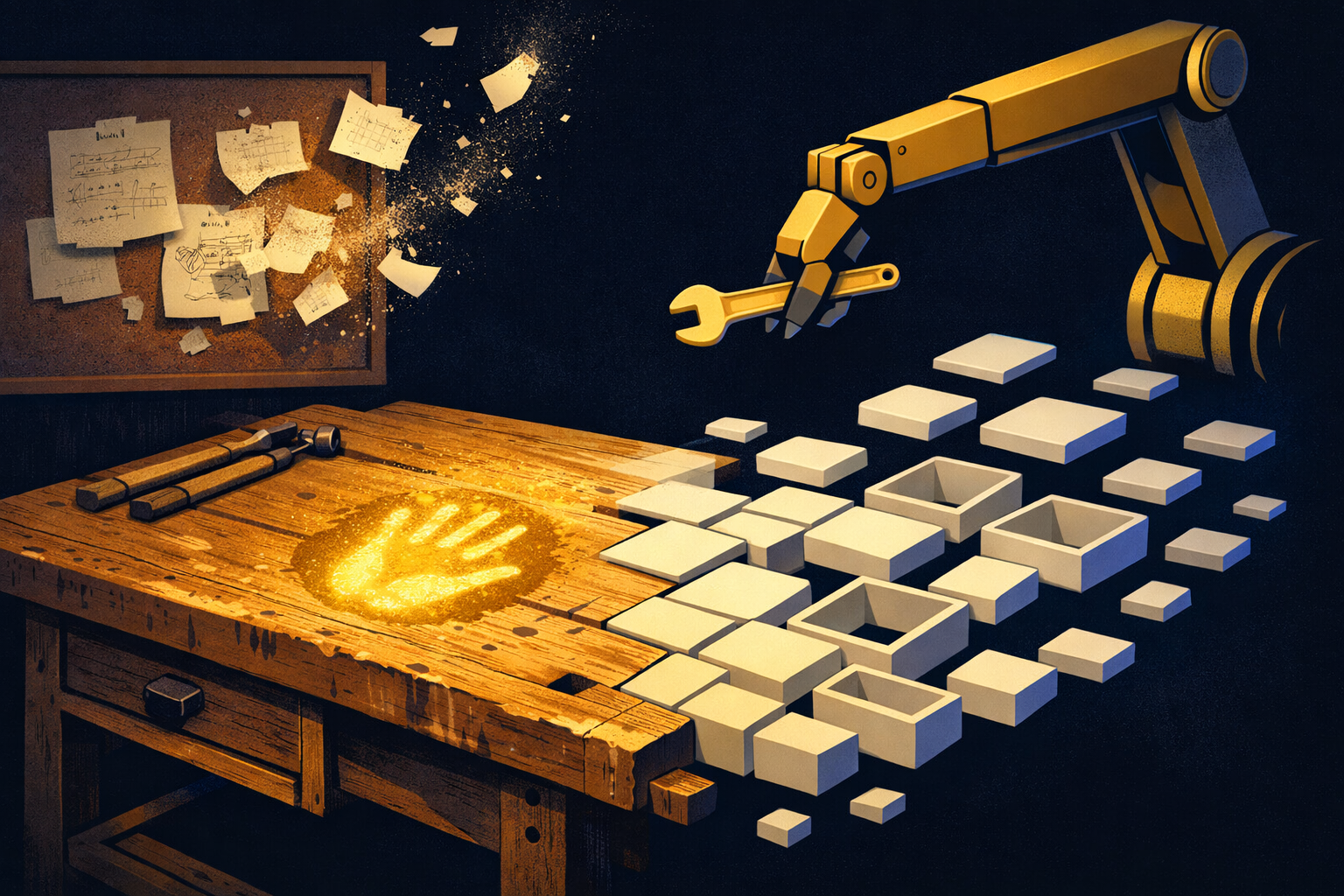
Economists have published over 300 major studies on AI and workforce displacement in the last five years — and almost none of them are measuring the right risk. The real danger isn't that AI replaces your people. It's that AI reshapes who does what, and in that reshuffle, your most critical operational knowledge vanishes before you notice it's gone.
If you're an ops leader, founder, or CTO trying to actually think through what AI transformation means for your org — not just abstractly, but in terms of real risk to real teams — this is the piece for you. We're going to cut through the displacement debate, name what's actually happening on the ground, and give you a concrete framework for protecting the thing most companies are about to lose.
The Key Answer Up Front: AI and Workforce Displacement Is the Wrong Frame
The displacement debate asks: will AI take jobs? The better question is: when AI changes how work gets done, what happens to the knowledge embedded in the humans whose roles shift? Those are completely different problems — and only one of them will actually hollow out your organization.
Research consistently shows that 70% of institutional knowledge lives in the heads of just 1-2 people per team. When AI automation changes those people's roles — even without eliminating their jobs — that knowledge doesn't automatically transfer to a system, a document, or a new hire. It just quietly disappears. That's the knowledge loss problem, and it's the one ops leaders should actually be losing sleep over.
What Does the Displacement Debate Actually Get Wrong?
The debate treats workforce displacement as a binary — employed or replaced — when the real transformation is a continuous reshuffling of who does what, and what gets lost in the process.
Most displacement discourse borrows its framework from prior automation waves — manufacturing, clerical work, call centers. The argument runs: AI will automate X% of tasks, therefore Y% of jobs are at risk. McKinsey estimates 30% of current work activities could be automated by 2030. Goldman Sachs put the number at 300 million jobs exposed globally. These are real numbers worth taking seriously.
But the framework misses something structural. In manufacturing automation, the worker left the floor and the machine replaced a physical motion. The knowledge of how to operate that machine was already codified in the machine's design. In knowledge work, the situation is inverted. The AI can perform the task — drafting, analyzing, routing — but the judgment about when to use which approach, which exceptions matter, which stakeholder needs what framing: that knowledge lives in a person. And AI can't absorb it just by automating the output.
The World Economic Forum's Future of Jobs Report found that 44% of workers' core skills will be disrupted within five years — not replaced, disrupted. That means the same people, doing different work, with different tools. The knowledge risk isn't from the people leaving. It's from the roles shifting while the knowledge stays unrecorded.
Why Is Knowledge Loss the Actual Risk During AI Workforce Transformation?
When a key contributor's role changes due to AI, their workflow knowledge doesn't transfer automatically — it evaporates. And 70% of it was never written down.
Think about what actually happens when a team introduces an AI tool that handles, say, first-pass customer support triage. The two support veterans who built those triage workflows over three years don't disappear. They get moved to higher-complexity cases, or to QA, or to prompt engineering. But the judgment they were applying — which cases escalate, which tone works for which customer segment, which edge cases have hidden SLA implications — was never formally documented. It lived in their heads and their habits.
Now the AI is doing the triage. The veterans are doing something else. And the next hire who joins that team has no way to learn those judgment patterns — because they no longer live in an observable role, and they were never captured. According to SHRM research, the average cost to replace a single employee runs between $15,000 and $20,000 when you factor in recruitment, onboarding, and lost productivity. But that calculation doesn't even touch the cost of the institutional knowledge that left with them — or shifted away from the role they vacated.
This is why the displacement debate is the wrong frame. The existential risk isn't headcount reduction. It's workflow amnesia at scale — your organization forgetting how it actually works, right in the middle of trying to transform how it works.
How Does This Play Out Across AI Adoption Stages?
Knowledge loss accelerates at every AI adoption stage — but the shape of the loss changes. Most orgs don't notice until Stage 3, when the damage is already compounding.
As covered in our piece on The 5 Stages of AI Workforce Transformation (And Where Teams Stall), AI adoption doesn't happen in a single wave. It moves through stages — from tool experimentation to process integration to agentic deployment. At each stage, the knowledge risk profile looks different.
- Stage 1 — Tool Curiosity: Individual contributors start using AI tools ad hoc. Risk is low but the undocumented workarounds they develop start creating invisible workflow forks — different people solving the same problem differently with no shared record.
- Stage 2 — Process Integration: AI tools get embedded in official workflows. Roles start shifting. The people who built the original process begin moving up or sideways. Their tribal knowledge starts detaching from any observable job function.
- Stage 3 — Workflow Automation: Entire task categories are handed to AI. New hires join teams where the previous human workflow no longer exists in observable form. Onboarding fails not because the content is missing — but because the real workflow was never captured before automation replaced it.
- Stage 4 — Agentic Deployment: AI agents are expected to operate with judgment, not just execute tasks. But the training data required to give them that judgment — real workflow patterns, decision logic, exception handling — was never systematically recorded. Agents hallucinate or default to generic behavior because the real organizational context was never fed into them.
- Stage 5 — AI-Native Operations: Teams that made it here without a knowledge capture strategy are operating on a brittle foundation. Their AI-augmented workflows are fast but fragile — any key departure, any role shift, and the system doesn't know what it doesn't know.
Enterprise ramp time for complex roles already averages 6-9 months — and that's before factoring in the added complexity of AI-augmented workflows that new hires need to learn but that were never formally documented in the first place.
Isn't This Just an Onboarding Problem? Why Isn't Documentation Enough?
Documentation captures what people say they do. Behavioral observation captures what they actually do. In high-stakes workflows, the gap between those two things can be enormous.
The instinct to solve this with better documentation is understandable — and mostly wrong. Standard documentation relies on self-reporting: you ask people to write down their workflows. But research on tacit knowledge consistently shows that experts are poor at articulating what they do. They can describe the steps, but not the judgment that sits between the steps. They'll write 'review the output' when what they actually do is pattern-match against three years of domain-specific failure cases.
This is the core argument in our piece on Why Your Employee Onboarding Process Keeps Failing — the systems built to transfer knowledge (onboarding platforms, wikis, SOPs) are built on self-reported workflows, which means they inherit all the gaps of what experts can't see in their own practice. You end up documenting the surface, not the substance.
The solution isn't to ask people to document better. It's to observe how work actually happens — capturing behavioral signals, decision points, and workflow patterns through passive observation rather than active self-reporting. That's the difference between a knowledge map and a knowledge snapshot that actually reflects reality.
What's the Difference Between AI Displacement Risk and AI Knowledge Risk?
It helps to put these in a direct comparison. Most organizations are spending resources managing one and ignoring the other entirely.
AI Displacement Risk vs. AI Knowledge Risk
- AI Displacement Risk — What it is: job elimination due to automation. Who tracks it: HR, economists, policy teams. Typical response: reskilling programs, change management, headcount planning.
- AI Knowledge Risk — What it is: institutional workflow knowledge lost as roles shift. Who tracks it: almost no one. Typical response: nothing systematic, because it's rarely measured.
- AI Displacement Risk — Visibility: high (job loss is measurable and visible). AI Knowledge Risk — Visibility: low (knowledge loss is invisible until operational failure surfaces).
- AI Displacement Risk — Timeline: medium-long term (role elimination takes time). AI Knowledge Risk — Timeline: immediate (knowledge leaves the moment the role changes or the person leaves).
- AI Displacement Risk — Fix: policy, training, new hiring. AI Knowledge Risk — Fix: behavioral observation and workflow capture before the role shifts.
What Should Ops Leaders Actually Do About This? Practical Steps
The good news: the knowledge risk created by AI transformation is manageable — but only if you get ahead of it. The window between 'role is changing' and 'knowledge is gone' is shorter than most leaders expect. Here's how to approach it.
- Map your single points of knowledge failure before you map your AI roadmap. Identify the 1-2 people per team whose departure or role change would create a critical workflow gap. This is your highest-priority capture target — not the easiest to document, but the most dangerous to ignore.
- Observe before you automate. Before any workflow gets handed to an AI tool or agent, run a behavioral observation period. Watch how the work actually happens — not how people describe it. Capture the decision logic, the exceptions, the informal communication patterns that never appear in any SOP.
- Treat workflow capture as AI training data, not just documentation. The same behavioral data that helps a new hire understand how work actually happens is exactly what AI agents need to operate with real organizational judgment. These aren't separate problems — they're the same data problem.
- Build knowledge capture into your AI transformation timeline, not after it. Most organizations run change management in parallel with AI rollout. Knowledge capture needs to precede the rollout — or you're automating a process whose real logic you've never actually recorded.
- Audit what your onboarding actually transfers. If new hires in AI-augmented roles can't reconstruct the judgment logic behind the workflows they inherit, your onboarding is failing — regardless of how good the platform is. As covered in The Employee Onboarding Program Most Teams Actually Need, the problem is usually upstream: the real workflows were never captured in the first place.
- Use workforce analytics to track knowledge concentration risk, not just performance. Metrics like task dependency concentration (how many workflows run through one person), informal network centrality, and cross-training coverage rates are early signals of fragility. Standard performance dashboards won't surface them.
The Agentic Layer Makes This Urgent, Not Optional
For orgs moving toward agentic AI — AI systems that operate autonomously across multi-step workflows — the stakes of knowledge capture go up dramatically. An AI agent operating on generic training data will do generic work. It won't know that your enterprise clients expect escalations routed through the VP relationship owner, not the account manager. It won't know that your compliance team flags anything touching jurisdiction X before legal sees it. That context doesn't exist in any LLM's training set. It exists in your org's behavioral history.
Gartner predicts that by 2028, 33% of enterprise software applications will include agentic AI. The organizations that will actually benefit from that capability are the ones that have already captured the real workflow logic that agents need to operate effectively. Everyone else will be deploying expensive, capable systems that run on impoverished context.
Summary: What to Take From This
AI and workforce displacement is a real phenomenon — but it's not the right frame for most ops leaders and founders. The more immediate, more manageable, and more consequential risk is the institutional knowledge that evaporates when AI reshapes who does what. Seventy percent of that knowledge already lives in just 1-2 heads per team. It was never documented before AI arrived. And it's getting harder to capture with every role that shifts and every workflow that moves from human to machine.
The leaders who will navigate AI transformation successfully are not the ones who build the best change management programs or the most aggressive automation roadmaps. They're the ones who capture how work actually happens before they change how work happens. That sequence — observe, capture, then transform — is the only one that doesn't leave a knowledge void where your institutional expertise used to be.
Next Step
If you want to understand what knowledge is actually at risk in your org right now — before your next AI rollout changes the answer — Starforce captures it through behavioral observation, not surveys. The result is a real map of how work happens, where knowledge is concentrated, and what needs to be captured before transformation begins. That's the conversation worth having.