AI Workforce Training Has a Data Problem Nobody's Naming
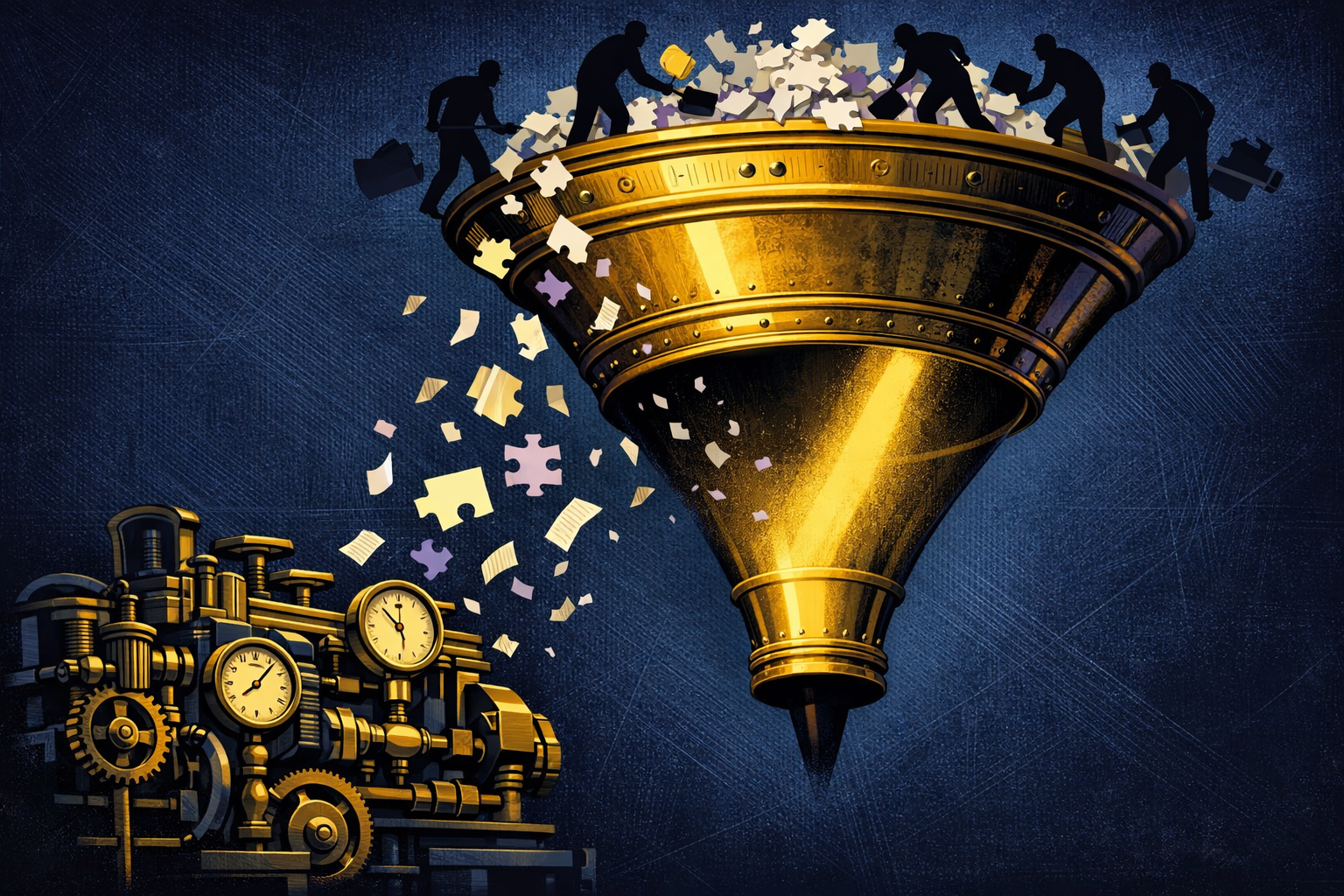
Companies are spending billions on AI workforce training programs, and the majority will fail — not because the technology is wrong, but because the training data feeding those programs was never captured in the first place.
This isn't a technology gap. It's a data gap. And almost nobody in the AI workforce training conversation is naming it directly. If you're an ops leader, L&D head, or CTO trying to build an AI-ready workforce, this article will explain exactly what's missing, why it breaks every program that ignores it, and what you need to do instead.
The root problem: AI workforce training is being built on workflow data that doesn't exist. Not because it can't be captured — but because nobody built the system to capture it.
What Does 'AI Workforce Training' Actually Mean Right Now?
AI workforce training covers two distinct problems: training humans to work alongside AI, and training AI agents to replicate or support human workflows. Most programs only address the first.
When most organizations talk about AI workforce training, they mean upskilling programs — teaching employees to use AI tools, prompting effectively, understanding model outputs. That's legitimate. But there's a second layer that's equally critical and almost universally ignored: training AI systems themselves to understand how your workforce actually operates.
AI agents, copilots, and automation tools don't come pre-loaded with knowledge of your processes. They need workflow data — real, behavioral, observed workflow data — to function in your specific context. Without it, you're deploying a general-purpose system into a specific-purpose environment and hoping it figures things out. It won't.
According to research from Deloitte, over 70% of enterprise AI deployments underperform against initial expectations. The most common reason cited isn't model quality or integration complexity — it's poor data about the processes the AI was supposed to support.
Why Does AI Workforce Training Keep Failing at the Foundation?
70% of institutional knowledge lives in the heads of 1-2 people per team. It was never written down — which means it was never available as training data for any AI system.
Here's the structural problem. Every organization has two versions of how work gets done. The first is the documented version: the SOPs, the process maps, the onboarding guides. The second is the real version: the shortcuts, the judgment calls, the exception-handling, the informal handoffs that experienced employees run on autopilot.
The documented version is what gets fed into AI training pipelines. The real version never gets captured. So every AI workforce development program — however sophisticated its delivery mechanism — is training on an incomplete, sanitized picture of actual work. It's the difference between teaching someone to cook from a recipe card versus watching a chef work a line.
This isn't a new observation. SHRM research has consistently shown that exit interviews and knowledge transfer sessions capture less than 30% of what a departing employee actually knew. The rest walks out the door. What's new is that AI systems now need that missing 70% to function — and nobody has a clean path to capturing it.
What's the Difference Between Workforce Training Data and Workflow Data?
Training data describes what employees should know. Workflow data describes what they actually do — and that behavioral layer is what AI agents need to operate in the real world.
Workforce training data is what most L&D functions produce: course completion records, skill assessments, competency frameworks, learning path data. This tells you what someone was taught. It does not tell you what they do when they open their laptop on a Tuesday morning and start working.
Workflow data is behavioral. It captures the sequence of actions, decisions, tool switches, communication patterns, and judgment calls that constitute actual job performance. It's the kind of data that can tell you: when this team receives a complex client request, here's the precise sequence of steps the best performers execute, including the three things they check that aren't in any SOP.
AI agents need workflow data, not just training data. An agent trained on course content and competency frameworks knows the theory of how a job works. An agent trained on observed behavioral workflows knows how the job actually works. The gap between those two states is why most enterprise AI deployments underdeliver.
How Does This Break Onboarding, Knowledge Retention, and AI Deployment Simultaneously?
The same missing layer — observed workflow data — is the root cause of three separate problems: slow onboarding, knowledge loss at attrition, and AI agent failure. They're not three problems. They're one.
Enterprise onboarding takes 6-9 months to reach full productivity, according to data from the Society for Human Resource Management. The reason isn't that new hires are slow learners. It's that the actual workflows they need to internalize were never documented — so they spend those months learning by osmosis, making mistakes, and gradually reverse-engineering how things really work.
The average cost to replace a departing employee sits around $15,000, but that figure doesn't account for the embedded workflow knowledge that leaves with them. When a senior operator exits, they take the real process — the exception-handling logic, the relationship context, the judgment calls — and none of it was ever written down. As covered in our piece on The AI Workforce Platform Landscape Has a Tribal Knowledge Gap, this problem predates AI but AI makes it catastrophically more expensive.
Now layer in AI deployment. You're trying to build agents that replicate or augment human workflows. But the workflows were never captured. So your AI program is, at its foundation, trying to automate something that was never documented. The result is an agent that handles the easy cases and fails on every edge case — which is exactly where human judgment was always most valuable.
Why Don't Existing Tools Fix This?
Surveys ask what employees think they do. Analytics platforms measure outputs. Neither captures the behavioral sequence between input and output — which is the actual workflow.
The standard toolkit for workforce intelligence includes HRIS systems, engagement surveys, workforce analytics platforms, and LMS data. Each of these tools measures something real. None of them capture behavioral workflows.
Here's a quick breakdown of what each tool sees — and what it misses:
- HRIS (Workday, SAP SuccessFactors): Captures headcount, tenure, compensation, role data. Sees nothing about how work actually gets done.
- Workforce analytics platforms (IBM, Visier): Surfaces aggregate patterns — attrition risk, performance distributions. Built on structured data inputs, not behavioral observation.
- LMS and L&D platforms: Tracks what was taught and completed. Does not track what was retained or applied in real workflows.
- Employee surveys: Measures perception and sentiment. Self-reported data is systematically inaccurate for capturing actual behavioral patterns.
- Process documentation tools: Captures the intended workflow. Never captures what experienced employees actually do when they deviate from the documented path.
The gap these tools share isn't a feature gap. It's a fundamental design gap. They were all built to measure outcomes, not to observe behavior. As covered in our piece on Why Most Companies Aren't Actually Building an AI-Ready Workforce, this design gap is the reason AI readiness programs stall even when the investment is serious.
What Does Solving the AI Workforce Training Data Problem Actually Require?
Fixing the data problem requires behavioral observation of real workflows — not better surveys, not more documentation, not smarter analytics on top of existing inputs.
The solution isn't a new way to ask employees what they do. It's a system that watches what they do — passively, continuously, and without creating documentation burden on the people whose workflows you're trying to capture. That's a fundamentally different category of tool than anything currently in the standard HR or L&D stack.
Behavioral observation at scale requires capturing: the sequence of actions within a workflow, the tools and systems touched at each step, the decision points where experienced employees deviate from standard process, and the patterns that distinguish high performers from average performers. This data, when captured correctly, becomes the foundation for all three use cases: onboarding acceleration, knowledge retention, and AI agent training.
Practical Steps: Building an AI Workforce Training Program That Actually Has Data
If you're an ops leader or CTO trying to move this forward in your organization, here's the sequence that actually works:
- Audit what workflow data you actually have. Pull your existing SOPs, onboarding documentation, and process maps. Assess honestly: does this reflect what your best performers actually do, or what someone wrote down two years ago? In most organizations, the answer is the latter.
- Identify the 2-3 roles where tribal knowledge concentration is highest. Start with roles where a single departure would create measurable performance impact — typically senior operators, key account managers, or specialized technical roles. These are your highest-risk, highest-value targets for workflow capture.
- Implement behavioral observation for those roles before your next AI initiative. Don't try to run workflow capture and AI deployment simultaneously. Capture first, deploy second. Running them in parallel means your AI program will be built on incomplete data from day one.
- Separate the data layer from the training layer. Workflow data should be a persistent, continuously updated asset — not something you capture once for an AI project. Build it as infrastructure, not as a project deliverable. It will serve onboarding, knowledge retention, and AI training simultaneously.
- Measure the right outputs. The success metric for this work isn't training completion rates or AI adoption scores. It's time-to-productivity for new hires, reduction in knowledge loss at attrition events, and AI agent accuracy on edge cases. These are the numbers that reflect whether your workflow data is actually good.
- Revisit your AI workforce training vendor selection criteria. Most vendors will show you demos built on clean, generic workflow data. Ask specifically: what is the mechanism for ingesting our organization's actual workflow data? If the answer is 'we connect to your existing documentation,' that's the wrong answer. Your existing documentation isn't the problem — the missing behavioral layer is.
The Comparison Most AI Workforce Programs Skip
Here's what AI workforce training programs look like with and without the workflow data layer:
- Training input — Without workflow data: Course content, competency frameworks, documented SOPs | With workflow data: Observed behavioral sequences, real decision patterns, exception-handling logic
- Onboarding outcome — Without workflow data: 6-9 months to productivity | With workflow data: Target 60-90 days with documented real workflows
- Attrition risk — Without workflow data: ~70% of role knowledge exits with the employee | With workflow data: Workflow is captured before departure, not after
- AI agent performance — Without workflow data: Strong on simple cases, fails on edge cases | With workflow data: Trained on real exception-handling, performs on edge cases
- Data freshness — Without workflow data: Static, updated when someone remembers to update it | With workflow data: Continuously updated as workflows evolve
The Bottom Line on AI Workforce Training
AI workforce training is a real and urgent priority. But the programs being built right now are largely training on the wrong data — or on data that doesn't fully exist yet. The documentation layer is incomplete. The behavioral layer was never captured. And AI systems can't compensate for that gap by being smarter models.
The organizations that will build genuinely AI-ready workforces aren't the ones with the biggest training budgets or the most advanced AI platforms. They're the ones that solve the data problem first — capturing how work actually happens, at the behavioral level, before they try to train anyone or anything on it.
As covered in our piece on The 5 Stages of AI Workforce Transformation, most organizations stall at the same point: they have the tools and the intent, but the workflow data that would make those tools work was never captured. That's not a technology problem. It's a sequencing problem. And it has a fix.
What to Do Next
If you're building an AI workforce training program, an onboarding system, or an AI agent deployment — start by asking one question: what is the source of our workflow data, and was it behaviorally observed or self-reported? If the answer is self-reported, documented, or survey-based, you're building on incomplete ground.
Starforce captures how teams actually work — through behavioral observation, not surveys or self-reporting — and turns that data into the foundation your onboarding, knowledge retention, and AI training programs actually need. If the data problem is blocking your program, that's the place to start.