The Employee Onboarding Survey Asks the Wrong Questions
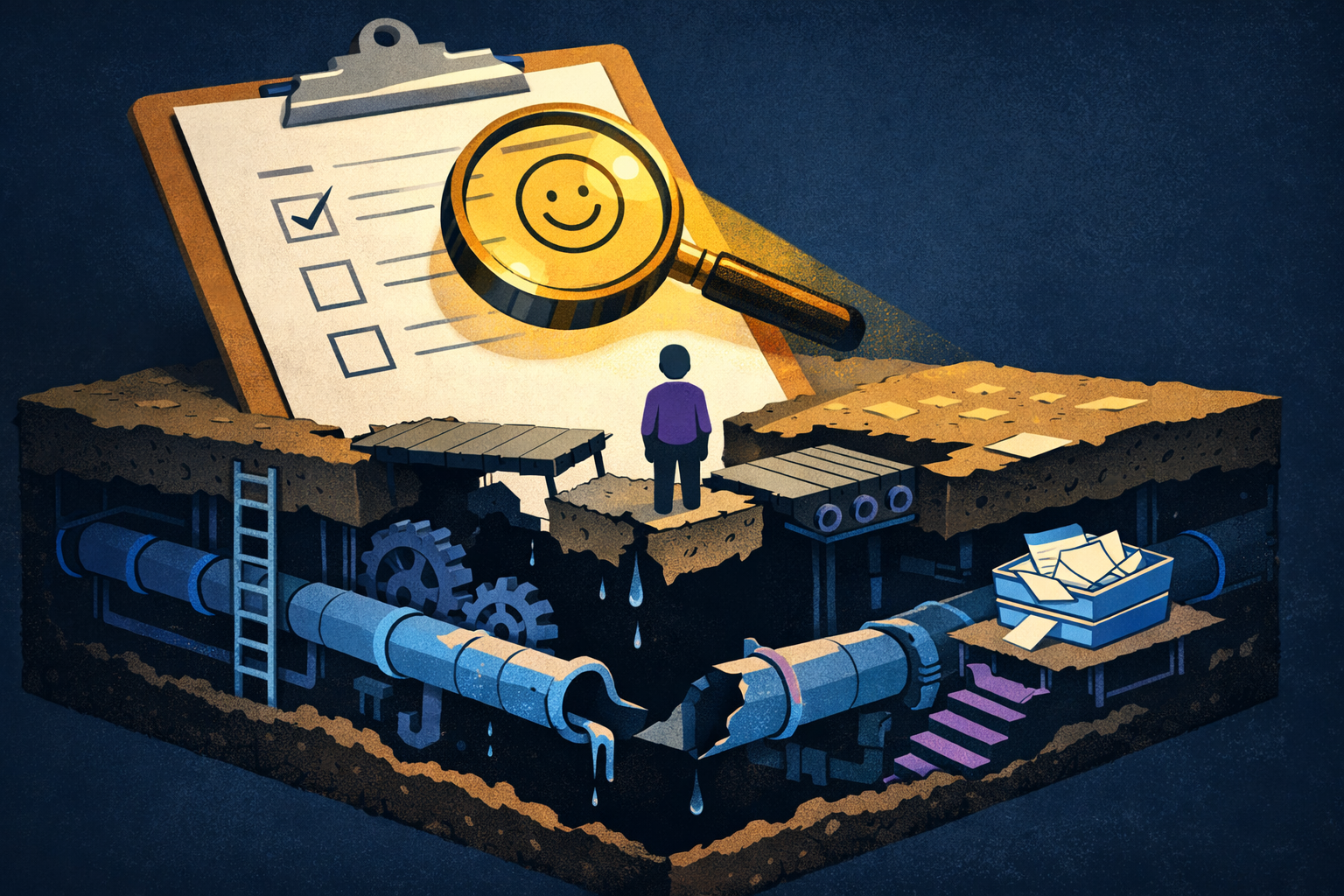
The average company runs an onboarding satisfaction survey at 30 days and calls it feedback. The only problem: satisfaction has nothing to do with whether your new hire can actually do the job.
This article is for L&D heads and ops leaders who suspect their onboarding surveys are measuring the wrong thing — and want to understand exactly what gap those surveys leave open, and what closing it actually requires.
The Key Answer: Employee Onboarding Surveys Measure Feeling, Not Function
An employee onboarding survey tells you whether a new hire felt welcomed, informed, and supported. It does not tell you whether they know how work actually gets done at your company. Those are two completely different questions, and most organizations are only asking the first one.
According to SHRM research, the average cost to replace an employee sits at roughly $15,000 — and that figure climbs steeply for senior or specialist roles. Enterprise ramp time for complex positions runs six to nine months. If a new hire finishes onboarding feeling great but operating at 40% effectiveness, your satisfaction scores are lying to you about your actual risk.
What Does a Typical Employee Onboarding Survey Actually Measure?
Standard onboarding surveys measure sentiment, clarity of communication, and perceived support — not whether real workflows were transferred.
Pull up any standard 30-day onboarding survey template. You'll find questions like: "Did you feel welcomed by your team?" "Was the training material clear?" "Do you understand your role and responsibilities?" "How would you rate your manager's support?"
These are experience questions. They measure perception. A new hire can score every one of them a 9/10 and still have no idea how the sales pipeline actually gets managed, which Slack channels carry the real decisions, or why the finance team uses a workaround nobody put in the SOP. That gap isn't captured by a survey. It lives in the heads of the two or three people the new hire needs to shadow — and most companies have never documented what those people actually do.
Research consistently shows that 70% of institutional knowledge lives in one or two people per team. That knowledge doesn't appear in job descriptions, onboarding portals, or welcome videos. And it doesn't show up in satisfaction scores either.
Why Do Onboarding Surveys Still Dominate L&D Measurement?
Surveys dominate because they are cheap, fast, and produce numbers that look like accountability — even when they measure the wrong thing.
L&D teams aren't collecting the wrong data because they're unsophisticated. They're collecting it because sentiment surveys are scalable, low-friction, and easy to present upward. An average onboarding satisfaction score of 8.2 out of 10 is a clean metric. "We still haven't documented how the account management team actually closes renewals" is not.
The Kirkpatrick model — the dominant L&D evaluation framework for decades — measures reaction, learning, behavior, and results. Most onboarding surveys don't even get to Level 2. They measure Level 1: reaction. Whether the new hire liked the experience. That is a vanity metric dressed up as program evaluation.
The harder measurement — whether new hires are actually replicating the behaviors and workflows of high performers — requires something surveys can't deliver. It requires knowing what those behaviors and workflows actually are before you can measure whether they've been transferred.
What Questions Does an Employee Onboarding Survey Never Ask?
No standard onboarding survey asks whether the new hire has learned the undocumented workflows that determine real-world performance in the role.
Here is a comparison of what standard onboarding surveys cover versus what actually predicts new hire productivity:
- Standard survey asks: "Did you feel supported by your manager?" — Productivity predictor: Has the new hire observed how their manager actually prioritizes and escalates issues?
- Standard survey asks: "Was the training material clear?" — Productivity predictor: Can the new hire replicate the end-to-end workflow the training was meant to describe?
- Standard survey asks: "Do you understand your role?" — Productivity predictor: Does the new hire know the informal decision-making paths that don't appear in the org chart?
- Standard survey asks: "Did you receive enough communication?" — Productivity predictor: Has the new hire been exposed to the real-time context that experienced teammates use to make fast decisions?
- Standard survey asks: "Would you recommend this onboarding to others?" — Productivity predictor: Is the new hire operating at the same efficiency level as their predecessor after 90 days?
None of the questions in the right column can be answered by asking the new hire how they feel. They require pre-existing documentation of how work actually happens — documentation most organizations have never created.
What Happens When Surveys Are the Only Onboarding Signal?
When surveys are the only signal, L&D teams optimize for experience scores while workflow gaps compound silently — and only surface when someone quits or fails.
Here is the failure loop most L&D teams are running, whether they know it or not. New hire joins. Survey shows satisfaction at 8/10. L&D reports a successful onboarding. New hire hits month four and is still asking basic process questions that slow the whole team down. Manager gets frustrated. New hire feels behind. Attrition risk spikes. Nobody connects that back to the survey score from month one.
Gallup research has found that only 12% of employees strongly agree their company does a great job onboarding. That number has barely moved in a decade. The companies in the other 88% are not all running bad onboarding programs — many of them are running well-designed, well-surveyed programs that still fail to transfer actual workflow knowledge.
As covered in our piece on why every onboarding guide, template, and checklist starts at step two, the root problem isn't a process problem. It's a documentation problem. Most onboarding programs describe an idealized version of the role, not how the role is actually executed by the people who are good at it.
Can You Fix an Onboarding Survey — or Is the Format the Problem?
You cannot survey your way to workflow transfer. The format is inherently limited to what new hires consciously perceive — which excludes most of what they don't yet know.
Some L&D teams try to fix onboarding surveys by adding behavioral questions: "Can you describe the steps you'd take to complete X process?" or "What's still unclear about how decisions get made?" These are better. But they still rely on the new hire knowing what they don't know — which, at 30 days, they often don't.
A new hire cannot tell you which workflows they're missing if they don't know those workflows exist. The senior account manager who has a 20-minute pre-call ritual that doubles close rates doesn't appear in any survey. The operations lead who knows exactly which three people to call when a vendor escalation hits doesn't either. These are invisible knowledge gaps — and surveys only surface visible ones.
The format isn't just limited — it's structurally wrong for the problem it's trying to solve. Surveys ask new hires to self-report on a reality they haven't fully entered yet.
What Should L&D Be Measuring Instead?
Effective onboarding measurement starts before the new hire arrives — by capturing the actual workflows of high performers in the role first.
The measurement problem is actually a documentation problem in disguise. You cannot measure workflow transfer if no one has captured what workflows need to be transferred. This is the step that precedes every onboarding survey, checklist, portal, and program — and almost no company has done it.
What needs to exist before any onboarding measurement is meaningful:
- Behavioral workflow documentation for the role — captured by observing how high performers actually work, not by asking them to describe it in a meeting.
- A defined set of workflow competencies the new hire needs to demonstrate by day 30, 60, and 90 — not feelings, not understanding, but observable behaviors.
- A manager verification layer that confirms workflow replication — separate from the new hire's self-report, and anchored to the captured behavioral baseline.
- A tribal knowledge audit that identifies which workflows are concentrated in one or two individuals — so those gaps are known before the new hire needs to fill them.
- Productivity signals at 60 and 90 days that are role-specific and tied to actual output — not engagement scores or satisfaction ratings.
Once you have behavioral documentation of how the role is actually performed, your onboarding survey can become something useful: a gap verification tool, not a sentiment tracker. You're asking "did we transfer these specific workflows?" instead of "did you feel good about it?"
Practical Application: What to Change in the Next 90 Days
This is not a theoretical problem. If you're an L&D head or ops leader with an active onboarding program, here is what to actually do — in order.
- Audit your current onboarding survey. Count how many questions measure sentiment versus workflow transfer. If it's more than 70% sentiment, your measurement is decorative.
- Identify your two highest-performing people in each role you hire regularly. Start behavioral observation of how they actually work — not interviews, not shadowing sessions where they describe what they do. Observe the real sequence: what they open, when, what decisions they make, what they escalate and what they handle alone.
- Build a workflow transfer checklist specific to each role — separate from your general onboarding checklist. This document lists the actual workflows a new hire must be able to execute independently before you consider onboarding complete.
- Restructure your 30-day survey to include at least five questions that reference specific workflows from that checklist. "Were you shown how X is handled?" is better than "Did you feel informed?"
- Add a manager-side verification at 60 days: have the hiring manager confirm which workflows the new hire has demonstrated — not reported, demonstrated. This creates a second signal that doesn't rely on new hire self-assessment.
- Track your 90-day voluntary attrition rate before and after this change. According to SHRM, organizations with strong onboarding improve new hire retention by 82%. Most of those gains come from closing workflow gaps, not improving welcome experiences.
The order matters. You cannot run step four without step two. Most onboarding programs skip straight to the survey and wonder why nothing improves.
The Broader Problem: Surveys Are a Symptom, Not the Disease
Onboarding surveys aren't wrong because L&D teams made a bad choice. They're wrong because they're trying to measure something that was never built — a documented, observable model of how work actually happens in your organization.
As we explored in our piece on why automated employee onboarding still fails at step zero, the automation tools, survey platforms, and onboarding portals all operate on the same flawed assumption: that the workflows new hires need were captured somewhere upstream. In most organizations, they weren't. The survey is just the last place that assumption fails visibly.
This also matters beyond onboarding. If 70% of institutional knowledge lives in one or two people per team, every new hire who doesn't absorb that knowledge is a retention risk — and a single resignation away from a critical knowledge gap. The survey doesn't surface that risk. It actively obscures it by reporting satisfaction while the gap compounds.
As covered in the piece on why most employee onboarding programmes keep failing, the five most common onboarding failure modes all trace back to this one root: the organization never captured what it was trying to transfer in the first place. The survey is just one of the tools left holding that bag.
Summary: What to Take Away From This
- Standard employee onboarding surveys measure sentiment, not workflow transfer — and the gap between those two things is where new hire productivity is lost.
- 70% of institutional knowledge lives in one or two people per team. Surveys cannot surface what new hires don't know they're missing.
- The Kirkpatrick model shows most onboarding surveys don't get past Level 1 — reaction — when behavior change at Level 3 is what actually drives productivity.
- The fix is not a better survey — it is capturing the behavioral workflows of high performers first, then measuring transfer against that baseline.
- Organizations with strong onboarding improve 90-day retention by up to 82%, according to SHRM — but those gains require measuring workflow replication, not experience scores.
Next Step
If your onboarding program is running on surveys and satisfaction scores, the first concrete action is the tribal knowledge audit: identify which workflows in each key role are undocumented and held by one or two people. That audit tells you what your onboarding has never transferred — and what your surveys have never measured.
Starforce captures how teams actually work through behavioral observation — not surveys, not interviews, not self-reported documentation. The output is a structured record of real workflows that L&D teams can use to build onboarding that transfers what actually matters. If you're ready to stop measuring sentiment and start measuring function, that is where the work begins.