Generative AI Can't Fix a Workforce That Never Documented Itself
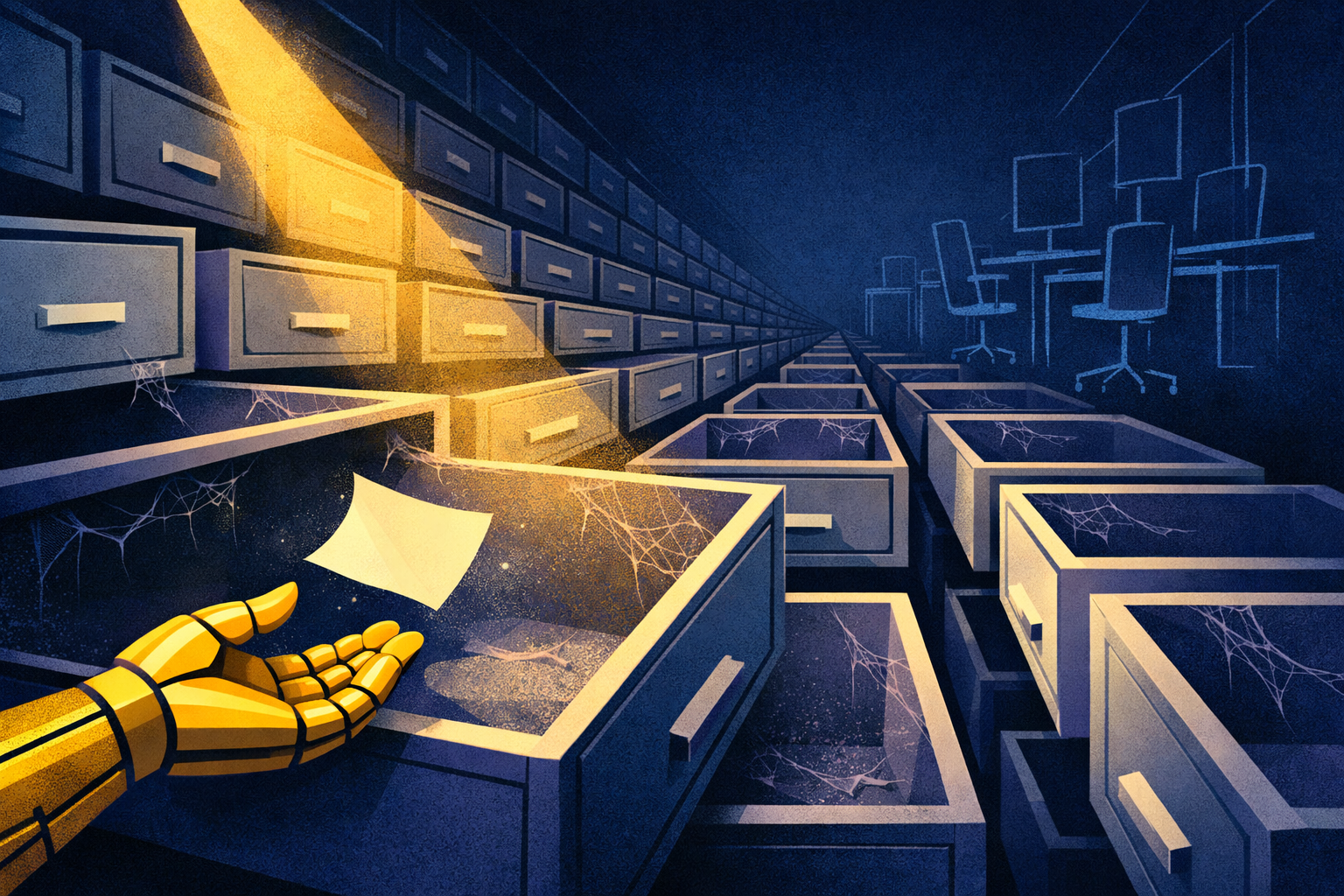
Seventy percent of institutional knowledge lives inside the heads of one or two people per team — and generative AI, for all its capability, cannot extract what was never written down. That's the problem nobody in the generative AI workforce conversation wants to name directly.
This article is for ops leaders, CTOs, and founders who are past the hype cycle and asking a harder question: if we deploy generative AI across our workforce, what does it actually have to work with? The answer, for most organizations, is less than they think. You'll get a clear-eyed view of how generative AI affects the workforce, where the real bottleneck sits, and what has to happen before any of the productivity gains become real.
The Key Answer: Generative AI Amplifies What's Already Documented — Nothing More
Generative AI is a force multiplier on documented knowledge. Most workforces have documented almost none of their real operating knowledge. So the multiplier is being applied to nearly zero.
This isn't pessimism about the technology. Generative AI is genuinely capable of accelerating content creation, summarization, code generation, customer interaction, and dozens of other tasks. The problem is upstream. Before a large language model can assist with a workflow, that workflow needs to exist somewhere in a form the model can learn from. For most teams, it doesn't.
What actually exists in most organizations: org charts, job descriptions, performance review data, HRIS records, and meeting transcripts. What's missing: how decisions actually get made, how exceptions get handled, which Slack message to send before a Jira ticket to avoid a three-day delay, and what the senior ops lead actually does differently from the playbook. That's the tribal knowledge layer. And it's the layer generative AI needs most.
How Does Generative AI Affect the Workforce When Tribal Knowledge Is the Ceiling?
Generative AI raises productivity for workers whose workflows are documented and creates a dangerous over-reliance gap for those whose workflows never were.
McKinsey's 2023 research estimated that generative AI could automate work equivalent to 60-70% of employee time in certain knowledge-work categories. That number circulates everywhere. What it doesn't say is that automation requires something to automate — a defined, repeatable process that can be encoded, prompted, or delegated to an AI system. When the process lives only in someone's head, no prompt in the world surfaces it.
The workforce impact of generative AI therefore splits into two tiers. Tier one: roles and teams where core workflows were already well-documented — software engineering with established codebases, legal teams with structured contract libraries, finance teams with defined close processes. These teams see real gains. Tier two: roles where the knowledge is experiential and behavioral — senior account managers, expert operators, founding-team veterans. These roles see AI tools land flat, because the model has nothing coherent to work with.
The brutal version: generative AI accelerates documented organizations and exposes undocumented ones. Most mid-market and enterprise teams are the latter.
Why Training Programs and Upskilling Initiatives Don't Solve This
Teaching employees to use generative AI tools before capturing how work actually gets done is training people to drive on roads that haven't been built yet.
The response from most organizations when asked about AI workforce readiness is to point at training spend. According to the World Economic Forum's Future of Jobs Report 2023, 60% of workers will require retraining before 2027. Billions are flowing into prompt engineering courses, AI literacy programs, and workforce development acts at the federal level. None of it touches the actual problem.
Training employees to interact with AI is a surface-layer fix. The deeper layer is the workflow data that AI systems need to actually assist with real work. A customer success manager trained in prompt engineering still can't extract institutional value from a generative AI tool if that tool has never been trained on how your specific renewal process works, how your escalation paths differ by segment, or what actually happens in the handoff between sales and CS. That knowledge has never been captured anywhere.
As covered in our piece on AI workforce training, every major training program and development act optimizes at the wrong layer — they build skills for a data environment that doesn't exist yet at most organizations.
What Does the Documentation Gap Actually Cost Before AI Enters the Picture?
The average cost to replace a departing employee sits at $15,000 — and that number doesn't count the undocumented workflow knowledge that walks out the door with them.
SHRM research puts average replacement cost at $4,129 for hourly roles and as high as $15,000-plus for knowledge workers, excluding lost productivity. That's the cost of the person. The cost of the knowledge they carried is uncalculated — because most organizations have no mechanism to measure what they've lost when a senior operator leaves.
Enterprise onboarding ramp time averages six to nine months for complex roles. That number hasn't improved materially in a decade despite onboarding software, LMS investments, and elaborate 30-60-90 day plans. The reason: new hires are being onboarded to the documented version of a job, not the actual job. The real workflows — the ones that determine whether someone becomes effective in three months or twelve — were never written down.
Now layer generative AI on top of this. If a new hire can't learn real workflows from a senior colleague because those workflows were never captured, they also can't learn them from an AI system. The AI has the same information gap the new hire does. Generative AI accelerates the retrieval of documented knowledge — it doesn't synthesize the undocumented kind.
The Three Places Generative AI Fails Without Behavioral Workflow Data
The failure isn't in the model. It's in the input. Here's where it shows up most directly:
- Fine-tuning and RAG applications: Organizations building custom AI assistants on top of foundation models — via fine-tuning or retrieval-augmented generation — hit a wall fast. The internal knowledge base they're pointing the model at contains policies, not practices. It contains the org chart, not the decision graph. The model retrieves what's there and misses everything that isn't.
- AI agent deployment: Agentic AI systems — designed to complete multi-step tasks autonomously — require workflow maps to operate reliably. Without them, agents either fail at handoff points, require constant human correction, or complete tasks in ways that look right but break downstream processes. As covered in our piece on what an AI agent workforce actually needs to function, the workflow data problem is the single largest blocker to production-grade agentic deployment.
- Workforce copilot tools: General-purpose copilots — Microsoft Copilot, Salesforce Einstein, etc. — surface generic suggestions rather than organization-specific ones because they haven't been trained on how your team actually works. The outputs are grammatically correct and contextually shallow. Users stop trusting them within weeks.
Surveys Won't Capture This. Neither Will Interviews.
People describe what they think they do, not what they actually do. Behavioral observation is the only method that captures real workflows at the resolution AI systems need.
The standard response to knowledge capture is some combination of exit interviews, knowledge transfer sessions, process documentation sprints, or enterprise wiki projects. These approaches fail predictably, for one reason: they rely on self-report. When you ask an expert to document what they do, they produce an idealized, compressed version of their work — the headline, not the operating logic underneath it.
Research in cognitive science has shown for decades that expert knowledge is largely tacit — held in procedural memory, not declarative memory. Experts can execute complex workflows fluidly precisely because those workflows are no longer consciously accessible. Asking them to describe it produces a sketch. The actual workflow requires observation to capture.
This is why Starforce is built around behavioral observation rather than self-report. The platform watches how work actually gets done — the sequence of actions, the decision points, the real tool interactions — and builds workflow maps from observed behavior. Not from what people say they do. What they actually do.
Generative AI Workforce Impact: What the Research Says vs. What It Assumes
Here's a direct comparison between what generative AI productivity research claims and the assumption that has to be true for those claims to hold:
- Claim: Generative AI can automate 60-70% of knowledge work time (McKinsey, 2023). Hidden assumption: The knowledge work being automated is already defined, repeatable, and describable to an AI system.
- Claim: AI copilots increase developer productivity by 55% (GitHub Copilot research, 2023). Hidden assumption: The developer's workflow exists in a well-documented codebase the tool can reference.
- Claim: AI can reduce onboarding ramp time significantly. Hidden assumption: The workflows new hires need to learn are captured somewhere the AI system can access and surface.
- Claim: Generative AI will reshape workforce planning and talent deployment. Hidden assumption: Organizations have a real map of how work flows through their teams — not just headcount data.
The productivity numbers are real in the studies — because the studies are typically run on teams whose workflows are already well-defined. Translating those numbers to an average enterprise team is where the projection breaks down.
How to Actually Prepare Your Workforce for Generative AI: Five Concrete Steps
This isn't a theory exercise. Here's the operational sequence for organizations serious about unlocking real generative AI impact:
- Identify your top 10 tribal knowledge holders. These are the people whose departure would cause the most operational damage. They are not always the most senior. They are the ones everyone goes to for real answers. Map who they are before you think about AI deployment.
- Capture workflows behaviorally, not through self-report. Observation-based tools — like Starforce — capture what people actually do, not what they say they do. This is the only input that produces workflow data at the resolution AI systems need for fine-tuning, RAG, or agent training.
- Build a real workflow library before you build your AI knowledge base. Most organizations point their AI systems at their existing documentation. That documentation describes policies, not practices. Build the workflow layer first — then connect the AI.
- Test AI tools against your hardest onboarding challenges. If a generative AI tool can't reliably onboard a new hire into a complex role faster than the current six-to-nine-month average, it doesn't have access to the right workflow data. Use onboarding as your diagnostic before committing to broader deployment.
- Sequence correctly: capture first, then automate. The failure mode for most AI deployments is automating before capturing. The result is a faster version of the same broken process. Capture the real workflow. Validate it. Then build the AI layer on top of it.
The Workforce Transformation Stall Nobody's Naming
Every conversation about how generative AI affects the workforce eventually arrives at transformation. New roles. New skill profiles. New productivity benchmarks. And every one of those conversations assumes a foundation that most organizations haven't built: a documented, observable record of how work actually gets done right now.
As covered in our piece on the stages of AI workforce transformation, teams stall at the same point repeatedly — not because AI tools are immature, but because the organizational knowledge layer underneath those tools was never captured. The technology is ready. The data isn't.
The organizations that will actually extract generative AI's productivity upside aren't the ones with the largest AI budgets or the most sophisticated models. They're the ones that solve the documentation problem first — that build a real, behaviorally grounded record of how their teams operate before they ask AI to replicate, assist, or extend that operation.
That's not a technology problem. It's a knowledge infrastructure problem. And it's entirely solvable — if you start with the right step.
Summary
- Generative AI amplifies documented workflows. It cannot synthesize or recover undocumented ones.
- 70% of institutional knowledge lives in 1-2 heads per team and has never been captured in any system.
- Upskilling programs and AI training initiatives operate at the wrong layer — they train employees without fixing the data problem underneath.
- Self-report documentation fails because expert knowledge is tacit. Behavioral observation is the only reliable capture method.
- The correct sequencing is: capture real workflows first, then build AI systems on top of that foundation — not the other way around.
If you want to understand exactly what's missing from your organization's workflow layer before your next AI deployment, Starforce can show you what's actually happening inside your teams — not what the org chart says should be happening.