What an AI Agent Workforce Actually Needs to Function
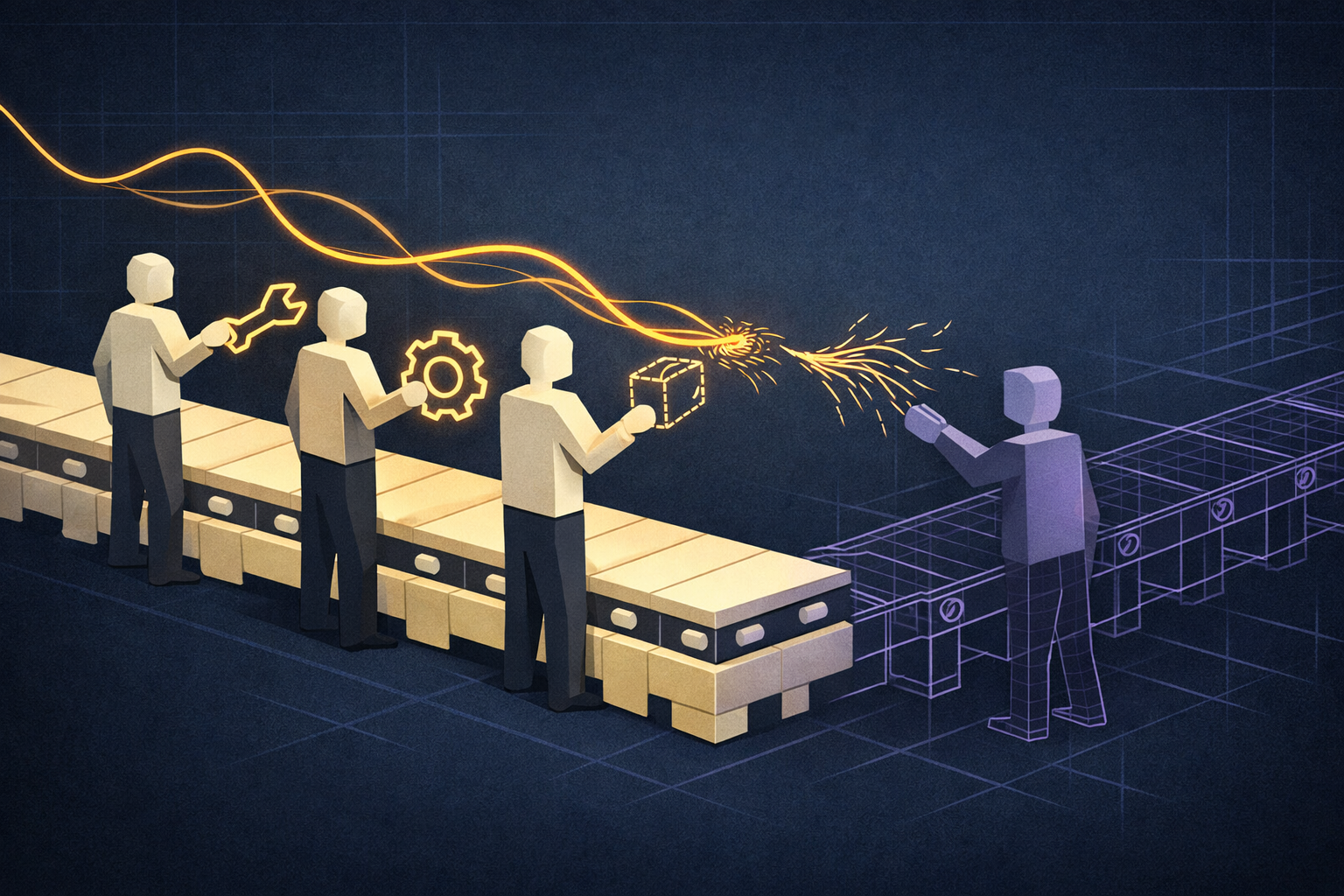
More than 70% of the workflow knowledge that makes your business run lives in the heads of one or two people — and AI agents can't extract it from job descriptions, org charts, or process docs that were never accurate to begin with.
If you're building or managing an AI agent workforce, that's not a trivia problem. That's a deployment problem. Most agentic AI initiatives stall not because the models aren't capable, but because the training data fed into them reflects an idealized version of work — not the real thing. This article breaks down exactly what an AI agent workforce needs to function, why most organizations aren't set up to provide it, and what to do about it before your next deployment cycle.
The Core Problem With AI Agent Workforce Deployments Today
AI agents don't fail because they're not smart enough. They fail because they're trained on documentation that describes how work is supposed to happen — not how it actually happens.
Here's the blunt version: most organizations building an AI agent workforce are feeding those agents process documentation written for compliance purposes, onboarding decks that nobody updated after 2021, and SOPs drafted by managers who aren't the ones doing the actual work. That's not workflow data. That's organizational fiction.
Real workflows involve judgment calls, informal communication patterns, exception handling, and tool-switching logic that never makes it into a document. An AI agent trained without that context will execute the documented version of a process while the actual humans around it continue operating on the undocumented version. The result is friction, errors, and eventually abandonment of the agent altogether.
What Does an AI Agent Workforce Actually Need to Function?
An AI agent workforce needs four things: accurate task sequences, decision logic, exception patterns, and cross-role handoff data — none of which exist in standard documentation.
Let's be specific. When an AI agent is assigned to handle a workflow — say, processing a vendor invoice, qualifying an inbound lead, or triaging a support ticket — it needs to know more than the official policy. It needs to know what a seasoned employee actually does when the edge case hits. That knowledge is almost never written down anywhere.
The four categories of data an AI agent workforce requires are distinct, and most organizations are missing at least three of them:
- Accurate task sequences: The actual order in which steps happen in practice, not the order listed in a policy doc. These frequently diverge.
- Decision logic: The criteria employees use to route, escalate, approve, or reject — including the informal thresholds that are never formally defined.
- Exception patterns: What happens when the standard flow breaks down. This is where 30–40% of real working time gets spent, according to workflow research from MIT.
- Cross-role handoff data: The exact moments where one person stops and another starts, including what information transfers, in what format, through which tool.
Without all four, an agent can execute tasks in isolation but can't participate in a real workflow. It becomes a very expensive macro — useful in narrow, controlled conditions and brittle everywhere else.
Why Standard Documentation Fails as AI Training Data
Process documentation is written to satisfy auditors and onboarding checklists — not to describe the actual cognitive load of doing the job.
SHRM research consistently finds that organizations lose significant institutional knowledge during every transition — new hire, promotion, or departure. The average replacement cost per departing employee sits around $15,000 when you account for recruiting, onboarding, and productivity loss. But that figure doesn't include the cost of the undocumented knowledge that left with them and is now missing from your AI training data.
Standard documentation has three structural problems as AI training data. First, it's written retrospectively and aspirationally — it describes what someone thought the process should be, after the fact. Second, it omits tacit knowledge by design; documentation writers don't know what they know, so they can't write it down. Third, it goes stale immediately and rarely has an owner with both the knowledge and the incentive to update it.
As we covered in The 5 Stages of AI Workforce Transformation, most organizations stall at stage three precisely because they try to skip the data capture step and go straight to deployment. The agents perform poorly, confidence drops, and the initiative gets shelved or scaled back — not because AI can't do the work, but because nobody gave it the right inputs.
What Makes Behavioral Observation Different From Surveys and Interviews?
Surveys capture what people think they do. Interviews capture what they remember doing. Behavioral observation captures what they actually do — in real time, at the task level.
This is the core methodological problem with most workforce data collection. When you ask a senior analyst how they process a complex report, they'll describe the official process because that's what they've been trained to articulate. They won't describe the three workarounds they use every Tuesday when the data pipeline is slow, or the Slack message they send to a colleague before submitting anything above a certain dollar threshold.
Behavioral observation — watching how work actually flows, what tools get used in what sequence, where people pause, where they improvise — captures the real signal. It surfaces the decision points that never appear in a flowchart and the informal communication that makes cross-functional handoffs actually work. That's the data an AI agent can actually learn from.
This is also why enterprise AI deployments have such dramatically long ramp times. The 6-to-9 month figure cited across enterprise transformation research isn't about model training time — it's about the time it takes to discover, through trial and error, what the real workflows actually are. Behavioral observation compresses that cycle by capturing the ground truth upfront.
AI Agent Workforce Management: What Changes When the Data Is Right
When AI agents are trained on real workflow data, AI workforce management shifts from firefighting failed deployments to optimizing agents that actually function as designed.
The operational difference is significant. Consider the comparison between deploying agents trained on documented workflows versus behavioral observation data:
Documented Workflow Training vs. Behavioral Observation Training
- Task accuracy in standard conditions — Documented: High | Behavioral: High
- Task accuracy in exception conditions — Documented: Low | Behavioral: High
- Cross-role handoff success — Documented: Poor | Behavioral: Strong
- Time to functional deployment — Documented: 6-9 months | Behavioral: Significantly compressed
- Knowledge retention after team turnover — Documented: Low | Behavioral: Preserved in agent training data
The second-order benefit matters as much as the first. When you've captured real workflow data to train AI agents, you've also solved the tribal knowledge problem for human onboarding. The same dataset that makes an agent functional makes a new hire ramp faster — because the real workflows are finally documented somewhere. This connection is explored in depth in our piece on why most companies aren't actually building an AI-ready workforce.
How to Build the Workflow Data Foundation Your AI Agent Workforce Needs
This is the practical section. If you're a CTO or ops leader reading this and you have an agentic deployment on your roadmap — or one that's already underperforming — here's the sequence that actually works:
- Identify the three to five workflows where AI agents would have the highest operational impact. Don't start with the easiest workflows. Start with the highest-value ones, even if they're complex.
- Map the 1-2 people who actually own each workflow in practice — not the person whose job description says they own it, but the person everyone goes to when something breaks.
- Observe those workflows behaviorally. This means watching actual work sessions, capturing tool usage sequences, recording decision points, and logging exception handling. This is not an interview. It is not a workshop. It is observation.
- Structure the captured data at three levels: task sequences, decision logic, and handoff triggers. Each level requires a different data schema and maps to different agent capabilities.
- Use exception patterns to build agent fallback logic before deployment. The most common deployment failures come from agents that handle the standard case well but have no logic for the edge cases that constitute 30-40% of real volume.
- Validate agent behavior against real workflow benchmarks — not against the documented process. The test is whether the agent handles actual work conditions, not ideal ones.
- Treat workflow data as a living asset. Re-observe quarterly for high-velocity workflows. Workflows drift; agents need to drift with them or they become obsolete faster than you expect.
The Workforce Intelligence Layer Most Deployments Skip
An AI agent workforce without a workforce intelligence layer is a fleet of autonomous vehicles without maps. The vehicles work. The routes don't.
Most organizations treat AI agent deployment as a technology problem — model selection, infrastructure, prompt engineering, integration. Those things matter. But the critical gap is almost always upstream: nobody has built a workforce intelligence layer that captures and maintains accurate workflow data.
A workforce intelligence layer does three things: it captures how work actually flows (not how it's supposed to flow), it identifies where institutional knowledge is concentrated and at risk, and it produces structured workflow data that agents — and new hires — can actually use. Without that layer, every AI deployment is building on an unstable foundation.
This also connects directly to the workforce analytics problem. As we covered in Workforce Predictive Analytics Can't Predict What It Can't See, predictive models built on top of incomplete workflow data produce predictions that look precise but are structurally unreliable. The same principle applies to agentic AI: garbage in, confident wrong outputs out.
What This Means for AI Workforce Management Going Forward
AI workforce management is becoming a real discipline — not a buzzword. As agentic deployments scale, managing an AI agent workforce means managing the quality of the workflow data those agents run on, the observability of how they're performing against real workflows, and the update cycles that keep them aligned with how work actually evolves.
The organizations that will get this right are the ones that stop treating workflow documentation as a compliance artifact and start treating it as a strategic asset. That shift isn't primarily a technology decision. It's an operational one. It requires someone in the organization to own the question: do we actually know how work gets done here?
If the honest answer is no — or partially — then no amount of model sophistication will save your deployment. The agents will be as blind as the data that trained them.
Summary: What an AI Agent Workforce Actually Needs
- Real workflow data — not documentation. Task sequences, decision logic, exception patterns, and handoff data captured through behavioral observation.
- A workforce intelligence layer that maintains and updates that data as workflows evolve — not a one-time documentation sprint.
- Exception logic built in before deployment, not added reactively after agents start failing in production.
- Validation against real workflows, not idealized process maps.
- Organizational ownership of the workflow data problem — a named person or team responsible for the accuracy of how work is represented to AI systems.
The AI capability gap most companies are trying to close isn't a model problem. It's a data problem. Specifically, it's a workflow data problem. Starforce captures that data through behavioral observation — not surveys, not interviews, not documentation audits — so your AI agents are trained on how your organization actually works. That's the difference between an AI agent workforce that functions and one that looks impressive in a demo and fails in production.