What Are Workforce Analytics, Really?
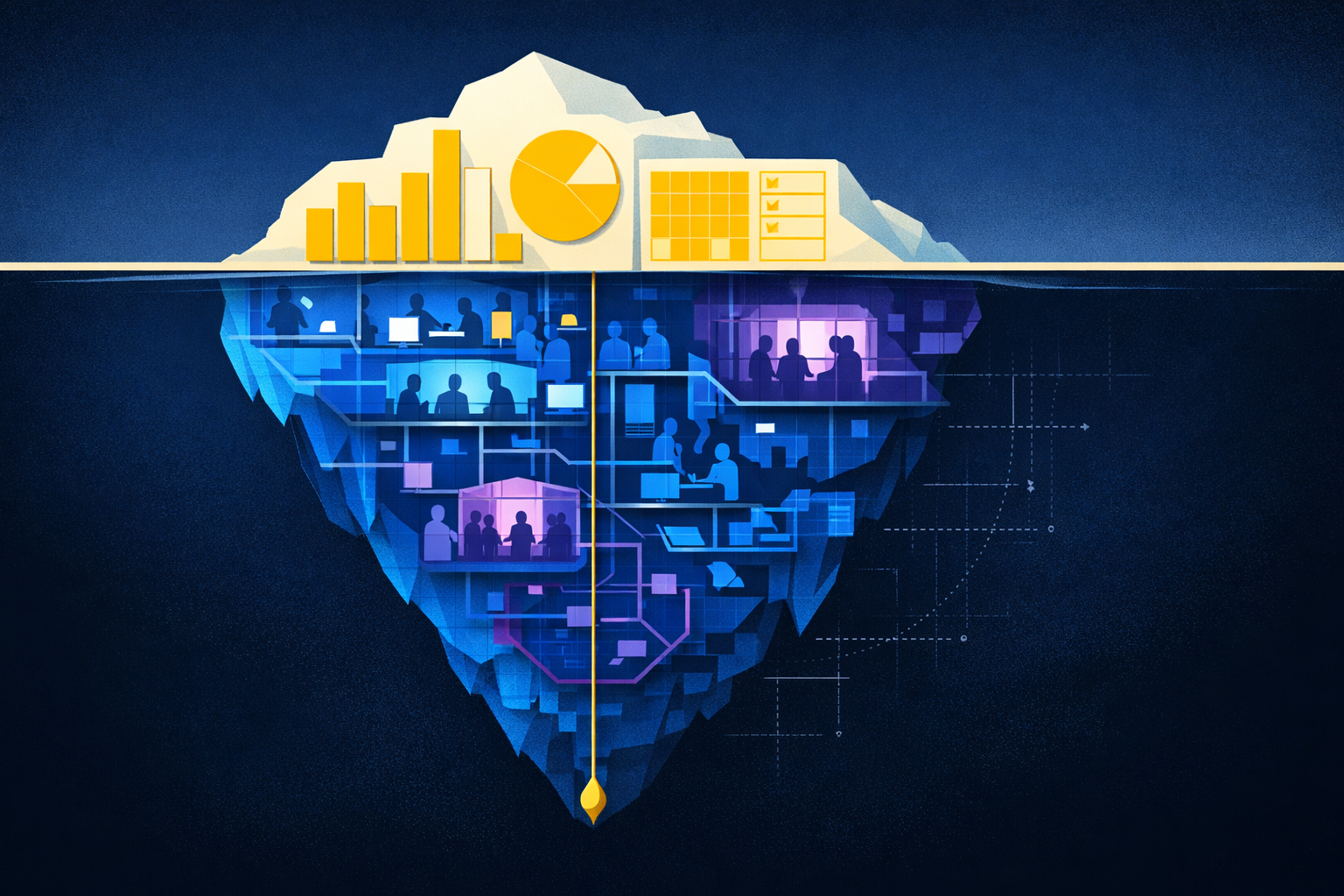
There are at least a dozen enterprise platforms that call themselves workforce analytics tools — and almost none of them agree on what workforce analytics actually is. That's not a branding problem. It's a data problem.
If you're an ops leader, founder, or head of L&D trying to make a real decision — which platform to buy, which metric to fix, which knowledge gap to close — the standard definitions aren't going to help you. This article gives you the honest answer: what workforce analytics actually is, what it measures, what it can't, and why the layer that matters most is the one every definition skips.
What Are Workforce Analytics? The Actual Definition
Workforce analytics is the systematic collection and analysis of data about employees — who they are, how they perform, and how they move through an organization — to inform decisions about hiring, retention, productivity, and structure.
That's the clean version. The working version is messier. In practice, what workforce analytics measures depends entirely on which platform you're using, what data that platform can actually access, and what questions your organization thought to ask when it set the system up.
Workday tracks headcount, attrition, and time-to-fill. SAP SuccessFactors layers in performance ratings and succession planning. Insightful and similar activity-monitoring tools measure application usage and active time at keyboard. IBM's workforce science products run predictive attrition models against historical HR data. These are all legitimately called workforce analytics — and they measure almost completely different things.
None of them capture how work actually happens. That gap is not a product limitation. It's a category limitation — and it's the reason the definition keeps failing smart people who need it to mean something.
What Does Workforce Analytics Actually Measure?
Most workforce analytics platforms measure workforce composition, movement, and output signals — not the workflows that produce those outputs.
Here's a practical breakdown of the four data layers most platforms actually touch:
- Headcount and composition data — who's employed, in what roles, at what cost, across which locations and business units.
- Movement data — hires, exits, internal transfers, time-to-fill, time-to-productivity estimates, and attrition rates.
- Performance and engagement signals — manager ratings, survey scores, goal completion percentages, 360 feedback outputs.
- Activity proxies — time in applications, meeting load, message volume, focus time blocks (primarily from monitoring tools).
Notice what's missing: the actual sequence of decisions, tools, and judgment calls a skilled employee makes to complete real work. You can see that someone closed 40 deals last quarter. You cannot see how they did it — which questions they asked, which objections they handled, which internal resources they knew to pull, which shortcuts they'd developed over three years. That's not captured anywhere.
Why Do So Many Definitions of Workforce Analytics Disagree?
Every platform defines workforce analytics based on the data it can actually collect — which means every definition is shaped by a product constraint, not an intellectual one.
SAP's definition emphasizes strategic HR planning because SuccessFactors integrates with core HR processes. Insightful's definition emphasizes productivity and utilization because its product monitors application activity. IBM's definition leans toward predictive people science because its platform runs statistical models on historical HR records. These aren't competing philosophies — they're marketing that describes what each tool can actually do.
The problem is that buyers interpret these definitions as complete answers. They buy a workforce analytics platform, get dashboards full of attrition rates and engagement scores, and still have no idea why their top performer's replacement is struggling six months into the role. The platform didn't fail. It just never claimed to answer that question — even though the buyer assumed it did.
As covered in our piece on the workforce analytics identity crisis, this definitional fragmentation isn't new — it's structural. The category grew from HR reporting roots, not operational intelligence roots, and it has never fully escaped that origin.
How Does Workforce Analytics Compare Across the Main Platform Types?
Platform type determines data layer. No single platform type covers all four layers — and none currently captures the workflow layer that sits beneath them all.
The table below maps the four main platform categories against the data layers they actually touch:
HRIS Platforms (Workday, SAP SuccessFactors) — Strong on headcount and movement data. Moderate on performance signals. Weak on activity data. No workflow capture.
Activity Monitoring Tools (Insightful, Teramind, ActivTrak) — Weak on headcount and movement context. Moderate on performance proxies. Strong on activity data. No workflow capture.
People Science Platforms (IBM Workforce Science, Visier) — Moderate on headcount data. Strong on movement and attrition prediction. Moderate on performance signals. No workflow capture.
Behavioral Observation Platforms (Starforce AI) — Captures the workflow layer beneath all four standard categories: the actual decision sequences, tool usage patterns, and judgment logic that produce performance outcomes.
What's the Workforce Analytics Layer That Every Definition Misses?
The missing layer is workflow intelligence: the documented record of how skilled employees actually perform work, captured through behavioral observation rather than self-report or output measurement.
According to research cited by SHRM and echoed across knowledge management literature, approximately 70% of institutional knowledge lives in the heads of one or two employees per function. It's not in your SOPs. It's not in your onboarding documents. It's not surfaced by your engagement survey. It lives in the behavioral patterns of people who've been doing the job long enough to develop judgment that works — and who almost never have the time or incentive to write it down.
When one of those people leaves, you don't lose a headcount. You lose the workflow. Your HRIS will flag the vacancy. Your attrition model may have predicted the departure. But no platform in the standard workforce analytics stack will tell you what that person actually knew — because no platform was ever observing it.
The cost of that gap is not abstract. The average cost of replacing a departing employee runs between $15,000 and $25,000 when you account for recruiting, lost productivity, and the extended ramp time of the replacement. Enterprise roles with specialized knowledge can run multiples of that figure. SHRM's workforce replacement cost research consistently places the total closer to 50-200% of annual salary for senior or highly specialized positions.
Enterprise new hire ramp time averages 6-9 months for complex roles — and that's when the workflow knowledge they need exists somewhere. When it was only in the head of someone who just left, the ramp doesn't shorten. It extends. Or the replacement never fully gets there.
Why Does This Matter for AI Deployments Specifically?
AI agents can only automate or replicate workflows that were documented somewhere. If the real workflow lived in one person's head and was never captured, the agent has no training signal to learn from.
This is where the workforce analytics question stops being theoretical and starts costing real money. Organizations deploying agentic AI — AI that operates autonomously inside workflows rather than just answering questions — discover quickly that the blockers aren't technical. The models are capable. The integrations can be built. The failure point is workflow data: the agents need real examples of how expert humans actually do the job, and that data was never captured.
As covered in our piece on what an AI agent workforce actually needs to function, the organizations making the most progress on agentic deployment are the ones that treated workflow documentation as an infrastructure problem — not a training problem — before they started building agents.
Standard workforce analytics platforms don't generate this data. They measure the workforce from the outside — outputs, movements, sentiment proxies. Capturing the workflow layer requires something different: behavioral observation at the point of work, not surveys after the fact.
How Should Ops Leaders Audit Their Own Workforce Analytics Stack?
The right audit question isn't 'what does our workforce analytics platform measure?' It's 'can our platform tell us how our best performers actually do their jobs?' If the answer is no, you have a gap.
Here's a practical five-step audit any ops leader can run:
- List the three roles in your org where one person's departure would cause the most operational disruption. Write down why. If the answer is 'they know how to do X', ask whether X is documented anywhere.
- Pull your last three significant new hire failures or extended ramp times. Identify whether the breakdown was skills-based (the person couldn't do the work) or knowledge-based (the person didn't have the workflow context they needed). Most orgs find the ratio is heavily skewed toward the latter.
- Ask your current workforce analytics platform a direct question: can it show you the step-by-step decision process your top sales rep uses to qualify an enterprise deal? Your top support engineer uses to diagnose a complex incident? If the platform can't answer in behavioral terms, you're measuring outputs, not workflows.
- Identify which roles are candidates for AI augmentation or automation in the next 12-18 months. Then ask: does the workflow data required to train or configure an AI agent for that role currently exist in any structured format? Be honest.
- Score your current stack against the four data layers listed above (headcount, movement, performance signals, activity proxies) — then add a fifth row for workflow intelligence. If that fifth row is empty, you know what to fix first.
What Are Workforce Analytics Supposed to Actually Deliver?
The original promise of workforce analytics was decision support: better data so leaders could make smarter calls about people, structure, and performance. That promise has been partially delivered. Attrition prediction models have genuinely improved. Hiring funnel analysis has gotten more rigorous. Compensation benchmarking is more data-informed than it was a decade ago.
But the promise was always bigger than attrition prediction. The implicit goal was understanding why some people perform at a level others don't — and then using that understanding to replicate performance, accelerate onboarding, and build organizational resilience. That goal has not been delivered. Not because the vendors haven't tried, but because the data required to deliver it was never collected.
As covered in our piece on workforce predictive analytics, even sophisticated predictive models fail when the underlying workflow data wasn't captured. You can predict that a high performer is likely to leave. You can't predict — or prevent — the knowledge loss that follows their departure if you never documented what they knew.
The Short Answer, Restated
Workforce analytics is the collection and analysis of data about how people work — but in practice, every mainstream platform stops at the surface layer: who's here, how long they stayed, how they scored on their review, how many hours they logged in Salesforce. The layer that drives actual performance, actual onboarding success, and actual AI deployment capability — the documented workflow layer — is not captured by any standard platform.
That's not a gap you can close with a better survey. It requires behavioral observation: watching how skilled people actually work, not asking them to describe it afterward. Because 70% of the knowledge that makes your org function lives in 1-2 heads per function — and those people are one resignation away from taking it with them.
What to Do Next
If you run the five-step audit above and find that your workflow intelligence row is empty, you're not alone. Most organizations discover this gap only when it costs them — a critical departure, a failed AI deployment, a new hire who never reaches full productivity. The organizations that get ahead of it treat workflow capture as infrastructure, not as an HR initiative.
Starforce AI captures real workflows through behavioral observation — not surveys, not interviews, not documentation requests that never get completed. The result is a living record of how your best people actually do their jobs: usable for onboarding, AI training, knowledge retention, and the workforce analytics layer that every other platform leaves blank.
That's what workforce analytics should have always included. Most platforms just never had a way to get there.