What Workforce Analytics Actually Measures (And What It Misses)
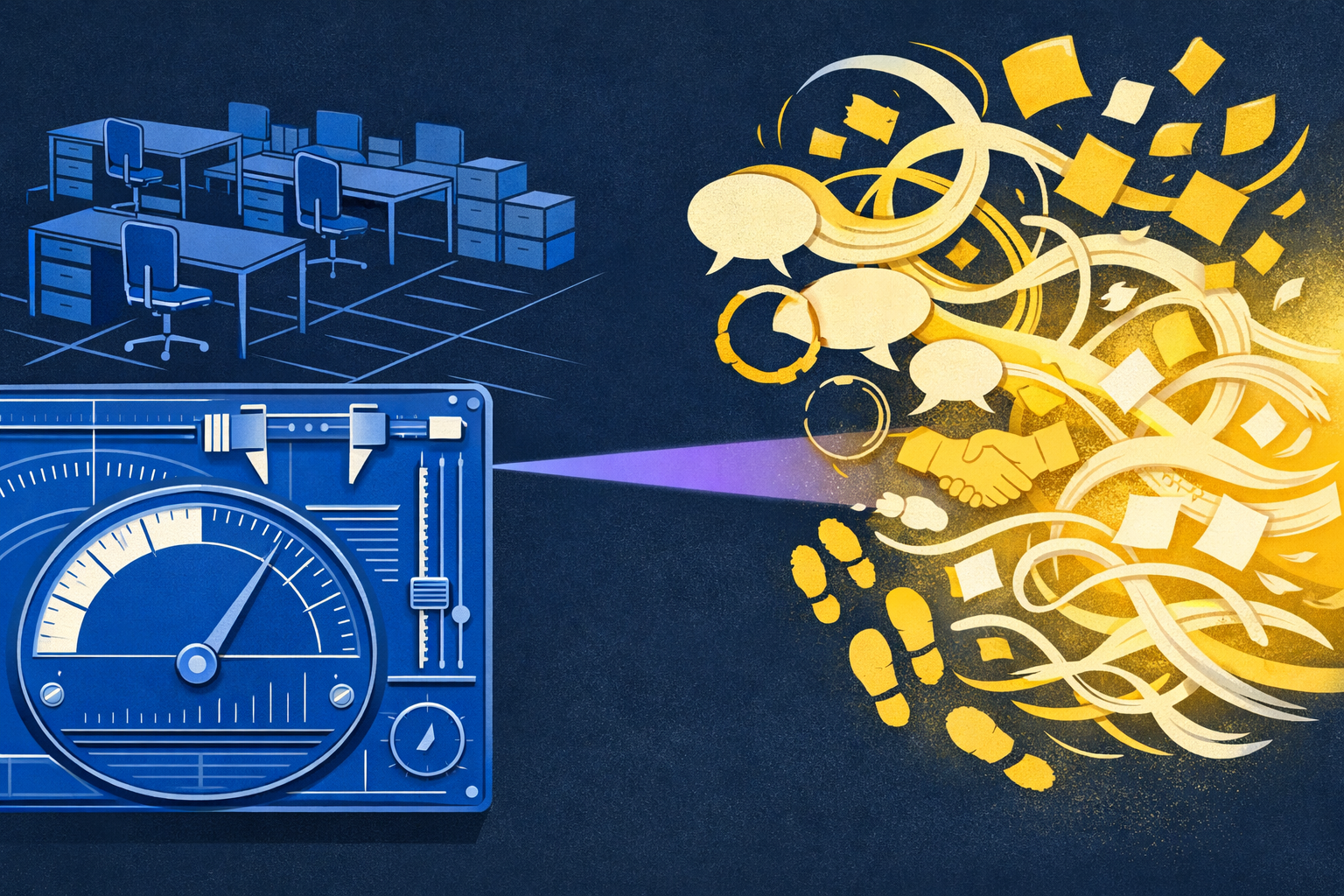
Most companies have more workforce data than ever — and less understanding of how work actually gets done than they did a decade ago. That gap is not a tooling problem. It's a measurement problem.
If you're an ops leader, head of L&D, or CTO trying to figure out what workforce analytics is — and more importantly, what it's worth — this article gives you the unvarnished answer. You'll learn what today's tools actually measure, where they structurally fail, and why the most operationally critical knowledge in your company stays completely invisible to every dashboard you're paying for.
Key answer: Workforce analytics measures inputs and outputs — headcount, performance scores, attrition rates, engagement surveys. It does not measure how work is actually performed. That distinction is costing companies millions in failed onboarding, knowledge loss, and broken AI initiatives.
What Is Workforce Analytics, Really?
Workforce analytics is the collection and analysis of employee data to inform hiring, retention, performance, and planning decisions — but it almost never captures actual workflow behavior.
The standard definition covers people data: who you employ, what they cost, how long they stay, how they score on reviews. Vendors like Workday, Visier, and Lattice have built sophisticated platforms around this data. They can tell you your 90-day attrition rate by department or correlate manager tenure with team engagement scores.
What they cannot tell you: how your best account manager actually closes a deal, what steps your senior engineer skips that junior engineers don't know to skip, or which Slack channels contain the real decision-making process that never made it into your JIRA tickets. That's not a feature gap. It's a category gap.
What Does Workforce Analytics Actually Measure?
Workforce analytics measures five categories: workforce composition, performance outputs, engagement signals, compensation benchmarks, and retention risk. Workflow behavior is absent from all five.
Here's what the major capability categories actually cover and what they leave out:
Workforce Composition
- Measures: headcount by role, department, tenure, location, and demographic breakdown
- Misses: which of those people are the actual knowledge hubs that others depend on daily
Performance Outputs
- Measures: OKR completion rates, quota attainment, review scores, project delivery
- Misses: the behavioral patterns and decisions that produced those outputs
Engagement and Sentiment
- Measures: pulse survey scores, eNPS, manager effectiveness ratings
- Misses: what people actually do versus what they say they do — a gap that survey-based data cannot close
Compensation and Benchmarking
- Measures: pay equity analysis, market rate comparisons, total rewards modeling
- Misses: the hidden cost of losing a person who carries workflows nobody else knows
Retention Risk
- Measures: flight risk scores based on tenure, engagement, and role fit signals
- Misses: the operational impact of that departure — which is often catastrophic and almost never quantified in advance
Why Does Workforce Analytics Miss Tribal Knowledge?
70% of institutional knowledge lives in the heads of 1-2 people per team. No workforce analytics platform has a data source that can capture it — because it's behavioral, not transactional.
Workforce analytics tools ingest structured data: HRIS records, performance management systems, survey responses, calendar metadata. These are all transactional signals — records of events that already happened. Tribal knowledge is not transactional. It's the unwritten logic that determines how events unfold in the first place.
According to SHRM research, the average cost to replace an employee is between $15,000 and $20,000 — and that figure doesn't account for the institutional knowledge that walks out with them. When a 7-year veteran leaves, you're not just paying a recruiter fee. You're losing an undocumented operating manual for a critical function.
The core problem: to capture how work actually happens, you need behavioral observation, not data extraction. You need to watch what people do — the sequence of steps, the informal checks, the judgment calls — not what they report doing. Traditional workforce analytics is built on the latter.
What Does Workforce Analytics Get Wrong About Onboarding?
Enterprise onboarding averages 6-9 months to full productivity. Workforce analytics can measure that timeline — but cannot explain it or compress it, because the bottleneck is undocumented workflow, not missing HR data.
Most L&D leaders have access to onboarding completion rates, time-to-productivity metrics, and 30-60-90 day review scores. They know the ramp takes too long. What they don't know is which specific knowledge gaps are creating the drag — because those gaps live in the behavior of their best performers, not in any system.
A new sales hire doesn't fail because they missed a training module. They fail because nobody captured the real sales motion — the specific sequence of touches, the objection-handling instincts, the product positioning nuances — that the top rep developed over three years. That knowledge exists. It's just locked in one person's head and invisible to every analytics dashboard.
This is a theme we've explored in depth in our piece on workflow blindness — the idea that the most important operational knowledge in a company is the kind that never gets written down because nobody thinks to document it until it's gone.
What Does Workforce Analytics Miss for AI Implementation?
AI agents need real workflow data to function — not org charts or performance scores. Without behavioral training data, enterprise AI deployments produce generic outputs that don't reflect how your company actually operates.
This is becoming one of the most expensive blind spots in enterprise AI investment. CTOs are deploying AI agents to automate workflows — customer support, contract review, sales follow-up — and hitting a wall. The AI can follow a generic process. It cannot replicate a company-specific process it has never seen documented.
According to McKinsey research, companies that successfully automate workflows report up to 30% productivity gains — but the prerequisite is having those workflows documented in the first place. Most don't. A 2023 Gartner survey found that over 60% of AI implementation failures cite poor or missing training data as a primary cause.
Workforce analytics as a category was built for HR decisions, not AI training pipelines. It was never designed to produce the kind of granular, behavioral, sequential workflow data that a language model or process automation agent needs to perform well. That's a new requirement — and the existing tooling doesn't meet it.
How Should You Think About Workforce Intelligence Beyond Analytics?
The next layer beyond workforce analytics is workforce intelligence — capturing not just who does what, but how they do it, in the actual sequence it happens, without relying on self-reporting.
Workforce intelligence platforms built on behavioral observation — rather than survey responses and HRIS exports — produce a fundamentally different output. Instead of a dashboard showing you that 23% of your team is flight risk, they show you which three people carry the tribal knowledge that would take 18 months to reconstruct if they left.
Instead of showing you that onboarding takes 6 months on average, they show you the specific workflow gaps that new hires hit in weeks 3 and 7. Instead of producing a performance score, they produce a documented workflow map that can actually train an AI agent or accelerate a new hire.
As covered in our piece on tribal knowledge capture, the shift from reporting to observation is not incremental. It requires a different instrumentation approach — one designed to watch how work unfolds rather than ask employees to describe it after the fact.
Practical Steps: What to Actually Do With This
If you're an ops leader, L&D head, or CTO, here's how to move from recognizing the gap to acting on it:
- Audit what your current workforce analytics actually outputs. List every report you generate in a given quarter. Separate the ones that tell you what happened from the ones that tell you how work was performed. Most organizations will find the second column is empty.
- Identify your tribal knowledge concentration risk. In every critical function — sales, ops, engineering, customer success — name the 1-2 people whose departure would create an operational crisis. Then ask: what percentage of their actual workflow is documented anywhere? The answer is almost always below 20%.
- Map your onboarding failure points behaviorally, not programmatically. Don't ask 'which modules did new hires miss?' Ask 'which specific decisions and workflows do they consistently get wrong in months 1-3?' Those are documentation gaps, not training gaps.
- Before your next AI agent deployment, produce a workflow documentation sprint. Have your top performers walk through their actual process — not in a meeting, but in live working sessions that can be observed and captured. This is the training data your AI needs and currently doesn't have.
- Evaluate workforce intelligence tools on one criterion: do they capture behavioral workflow data, or do they aggregate existing HR system outputs? The first type solves the problem. The second type is workforce analytics repackaged with a better UI.
The Bottom Line on What Workforce Analytics Measures
Workforce analytics is a mature, useful category that answers one class of question well: what is happening with your workforce at a structural level? Headcount, cost, attrition, engagement scores — all valuable for planning and HR operations.
It does not — and was never designed to — answer the question that actually determines operational resilience: how does work get done, and what happens when the people who know how to do it leave? That question requires a different approach entirely.
The companies that will outperform in the next five years are not the ones with the best attrition dashboard. They're the ones that captured how their best people work before those people left — and built that knowledge into their onboarding programs, their standard operating procedures, and their AI systems.
Workforce analytics tells you someone left. Workforce intelligence tells you what left with them — and gives you a fighting chance to keep it.
Starforce captures how your team actually works — through behavioral observation, not surveys — so that tribal knowledge gets documented before it disappears, onboarding gets built on real workflows, and your AI agents have the training data they actually need. If you're ready to see what your workforce analytics is missing, start with a workflow audit on your highest-risk team.