Why Most Companies Aren't Actually AI-Ready (And How to Fix It)
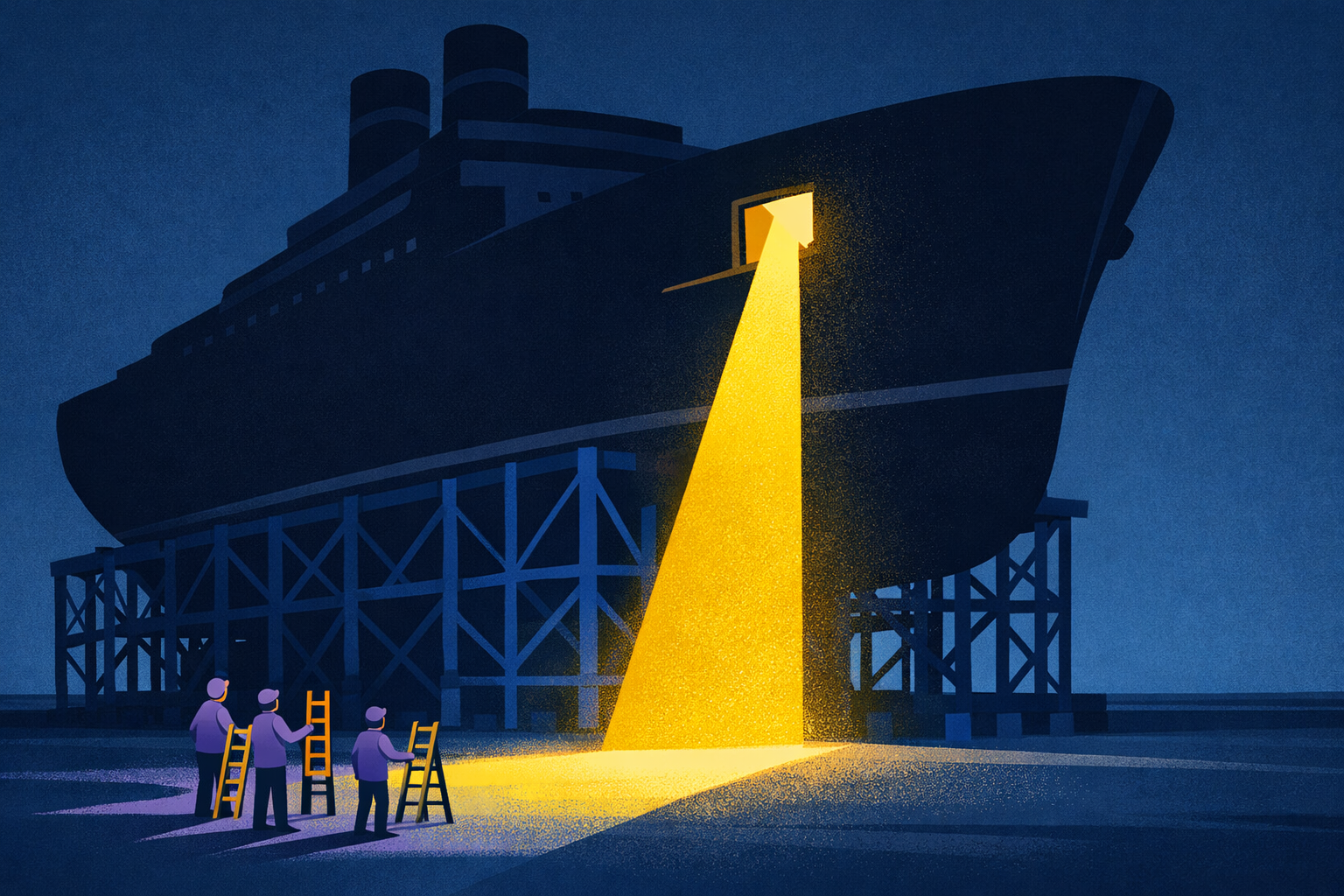
Eighty-five percent of enterprise AI initiatives stall before they reach production — not because the models are bad, but because the organizations deploying them don't actually know how their own work gets done. That's not a technology problem. That's a knowledge infrastructure problem.
If you're an ops leader, CTO, or founder trying to figure out why your AI deployment keeps hitting a wall, this article will give you a clear diagnosis and a concrete path forward. We'll cover what it actually means to have an ai-ready workforce, why most readiness frameworks miss the real bottleneck, and what the companies successfully deploying AI are doing differently right now.
The bottleneck isn't AI capability. It's that most organizations cannot hand an AI agent a coherent, accurate picture of how work actually flows through their teams.
What Does It Actually Mean to Have an AI-Ready Workforce?
An ai-ready workforce is one where institutional knowledge is documented, workflows are observable, and real process data exists to train and direct AI agents accurately.
Most definitions of AI readiness focus on tools — does your team know how to use ChatGPT, have you rolled out Copilot, are people prompt-literate? That framing is almost entirely wrong. Tool adoption is the easy part. The hard part is giving AI agents something accurate and structured to work with.
An AI agent handling customer escalations needs to know the real escalation path — not the org chart version, but the actual sequence of people, tools, and judgment calls your best reps use. An AI agent summarizing a sales process needs to understand what your top closers actually do between first call and signed contract. None of that lives in your CRM. It lives in the heads of two or three people on your team.
According to research cited by MIT Sloan Management Review, roughly 70% of institutional knowledge in most organizations is held by just 1-2 key people per function. That means the moment you try to automate or augment that function with AI, you're immediately dependent on extracting knowledge from individuals who are usually too busy to document it — and may not even know how to articulate what they do.
Why Do So Many AI Deployments Stall?
AI deployments stall because organizations try to automate workflows that were never formally captured — leaving agents to hallucinate process logic or default to generic behavior.
The typical AI deployment cycle looks like this: leadership gets excited, buys a platform or builds a model, hands it to a team, and then watches it underperform for 6-12 months before the project quietly dies. The post-mortem almost always points to the same cause — the AI didn't have good enough context about real processes.
There are three specific failure modes that drive this. First, documentation that doesn't reflect reality — your SOPs say one thing, your team does another, and the AI learns from the SOPs. Second, workflow data that's too sparse — you have outcomes in your system of record but not the steps and decisions that produced them. Third, tribal knowledge that's inaccessible — the people who know how things really work aren't the ones writing the training prompts or building the agent logic.
Gartner has consistently flagged poor data quality and missing process context as the top reasons for AI project failure, not model selection or infrastructure. The gap is almost always upstream of the model.
What's the Real Gap Between AI-Ready and AI-Stuck Organizations?
The gap is observable workflow data. AI-ready organizations have captured how work actually happens. AI-stuck organizations are guessing.
The comparison below isn't about company size or budget. Plenty of well-funded enterprises are deeply stuck. The difference is almost always about whether leadership treated knowledge capture as infrastructure before trying to automate.
AI-Ready Organizations vs. AI-Stuck Organizations:
- AI-Ready: Workflows documented through behavioral observation, not just self-reported surveys. AI-Stuck: Relies on employee-filled surveys or outdated SOPs that no one reads.
- AI-Ready: Institutional knowledge is distributed — multiple team members understand the real process. AI-Stuck: 1-2 people hold 70% of critical workflow knowledge.
- AI-Ready: Onboarding uses real workflow data — new hires ramp in under 90 days. AI-Stuck: Ramp time is 6-9 months because new hires have to absorb knowledge by shadowing.
- AI-Ready: AI agents trained on real process sequences and edge-case handling. AI-Stuck: AI agents running on generic prompts and best-guess logic.
- AI-Ready: Attrition risk is low because knowledge doesn't leave with individuals. AI-Stuck: Each departure costs $15K or more in replacement costs plus months of re-learning.
Why Surveys and Interviews Don't Solve the Knowledge Problem
People can't accurately describe their own workflows. Observation-based capture gets 3-5x more decision points than self-reporting — because experts skip steps they've automated cognitively.
This is the part most L&D and ops teams get wrong. They send out a questionnaire asking people to describe how they do their jobs. They get back vague, incomplete answers — not because employees are uncooperative, but because human cognitive science tells us that experts compress their knowledge. The more proficient someone is, the less consciously aware they are of the micro-decisions they make.
A senior customer success manager who's resolved 2,000 escalations doesn't think step-by-step anymore. They pattern-match instantly. Ask them to document their process and you'll get a five-step summary that skips 80% of what actually makes them effective. That five-step summary is what gets handed to the AI agent. And then everyone wonders why the agent keeps making bad decisions.
Behavioral observation — watching and capturing what people actually do, not what they say they do — consistently surfaces 3-5x more actionable process detail. This is the foundational insight behind how Starforce approaches workforce intelligence. The data you need to train AI agents and accelerate onboarding cannot be collected through a form.
What Does the Tribal Knowledge Problem Actually Cost?
Every key departure costs an average of $15K in direct replacement and 6-9 months of productivity loss — and that's before you account for the institutional knowledge that walks out the door permanently.
SHRM research puts the average direct cost of replacing an employee at 50-200% of their annual salary. For a $75K role, that's $37,500 to $150,000 when you factor in recruiting, training, and lost productivity. Even using the conservative $15,000 figure for individual contributor roles, the math becomes serious fast at any company with meaningful headcount or turnover.
But the real cost isn't the direct replacement. It's the compounding knowledge loss. When the person who knew the actual workflow leaves, the team reverts to a less effective version of the process. The new hire learns the degraded version. The AI agent trained on that data gets an even worse signal. Each cycle erodes process quality in ways that don't show up clearly on any dashboard.
This is a point worth sitting with if you're planning an AI deployment. Your training data quality is a direct function of whether your institutional knowledge has been captured before your best people leave. If it hasn't been, you're not building on a foundation — you're building on what everyone remembers.
How to Actually Build an AI-Ready Workforce: A Practical Framework
AI readiness is built in four sequential stages: observe real workflows, document the actual knowledge, structure it for agent training, then deploy and iterate with real feedback loops.
This isn't a theoretical framework. It's the operational sequence that distinguishes companies deploying AI productively from those stuck in perpetual pilot mode. Here's how to execute each stage.
Stage 1: Observe Before You Document
- Identify the 3-5 workflows most critical to your AI deployment target — not all workflows, just the ones that will determine whether your agent succeeds or fails.
- Use behavioral observation tools or structured session recordings to capture what your best performers actually do — every tool switch, every decision point, every shortcut.
- Do not rely on what people say in interviews. Watch what they do. The gap between stated process and actual process is where your AI training data quality lives.
Stage 2: Convert Observations into Structured Knowledge
- Map each observation into a structured workflow format that includes: trigger, decision criteria, action sequence, tool used, exception handling, and expected output.
- Flag every step where individual judgment is applied. These are the moments AI agents most often fail, and they're the moments that never appear in standard SOPs.
- Validate the documentation by having a second team member attempt to execute the workflow using only what's been written. Where they get stuck or deviate, the documentation is incomplete.
Stage 3: Structure Data for Agent Training
- Convert your documented workflows into agent-readable formats: instruction sets, decision trees, or fine-tuning datasets — depending on your deployment architecture.
- Include real edge cases and exception paths. A model trained only on the happy path will fail the moment reality deviates — which is constantly.
- Keep the source observation data linked to the training data so you can trace agent behavior back to specific process decisions. This makes debugging dramatically faster.
Stage 4: Deploy with Real Feedback Loops
- Build in human review for agent decisions during the first 90 days — not to slow things down, but to catch the specific decision points where your training data was weak.
- Every agent error is a knowledge gap. Route corrections back into the workflow documentation and retrain. The feedback loop is the mechanism — treat it as the product, not the afterthought.
- Set a 90-day review cadence to assess whether the documented workflows are drifting from actual team behavior. Processes evolve — your training data has to evolve with them.
The Onboarding Problem Is the Same Problem
It's worth naming something explicitly: the knowledge infrastructure problem that blocks AI deployment is the exact same problem that makes onboarding slow and expensive. The 6-9 month enterprise ramp time isn't a training design failure — it's a knowledge capture failure. New hires take that long because the real workflow isn't written down anywhere they can access it.
When you build the knowledge infrastructure to make your AI agents effective, you simultaneously solve your onboarding problem. New hires get access to documented real workflows, not sanitized process maps. They ramp faster because they're learning from what actually works, not what someone thought was happening six months ago.
This is a point covered in depth in our piece on why onboarding fails — the root cause consistently traces back to undocumented tribal knowledge, not insufficient training content.
Where Most Companies Should Start Right Now
Don't try to capture everything at once. Pick the single highest-leverage workflow in your organization — the one that, if your AI agent handled it well, would create the most measurable business impact. Start there.
For most companies, this is either a customer-facing resolution workflow or a core internal operations process that touches revenue directly. Get two or three of your best performers observed and documented. Build the training data from those observations. Run your first agent deployment against that workflow only.
When that deployment works — and it will work better than anything you've tried before, because you're finally giving the agent real information — you'll have a repeatable methodology to expand across the organization. That's the template. Build it once, right, on a contained scope. Then scale.
The Summary: AI Readiness Is a Knowledge Infrastructure Problem
Here's the short version. Seventy percent of your institutional knowledge lives in 1-2 heads. Your SOPs don't reflect what actually happens. Your AI agents are being trained on incomplete, self-reported process data. That's why they underperform. That's why your onboarding takes 6-9 months. That's why attrition costs you $15K or more per departure even before the knowledge loss is priced in.
An ai-ready workforce isn't defined by which tools your team uses. It's defined by whether the real knowledge of how work gets done has been captured, structured, and made available — to new hires, to AI agents, and to the organization as a whole. That infrastructure is what separates companies deploying AI productively from companies stuck in perpetual pilots.
The good news: this is a solvable problem. The methodology exists. The technology to do behavioral observation at scale exists. What's been missing for most organizations is the recognition that this is the work — not just a prerequisite to the work.
Your Next Step
Start with an honest audit: pick your highest-leverage workflow and ask how many people could execute it accurately using only what's currently documented. If the answer is fewer than three, you have a knowledge infrastructure gap that will block any AI deployment you attempt. That's where Starforce starts — capturing how work actually happens, so your organization stops guessing and starts building on solid ground.